What should a small business website do?
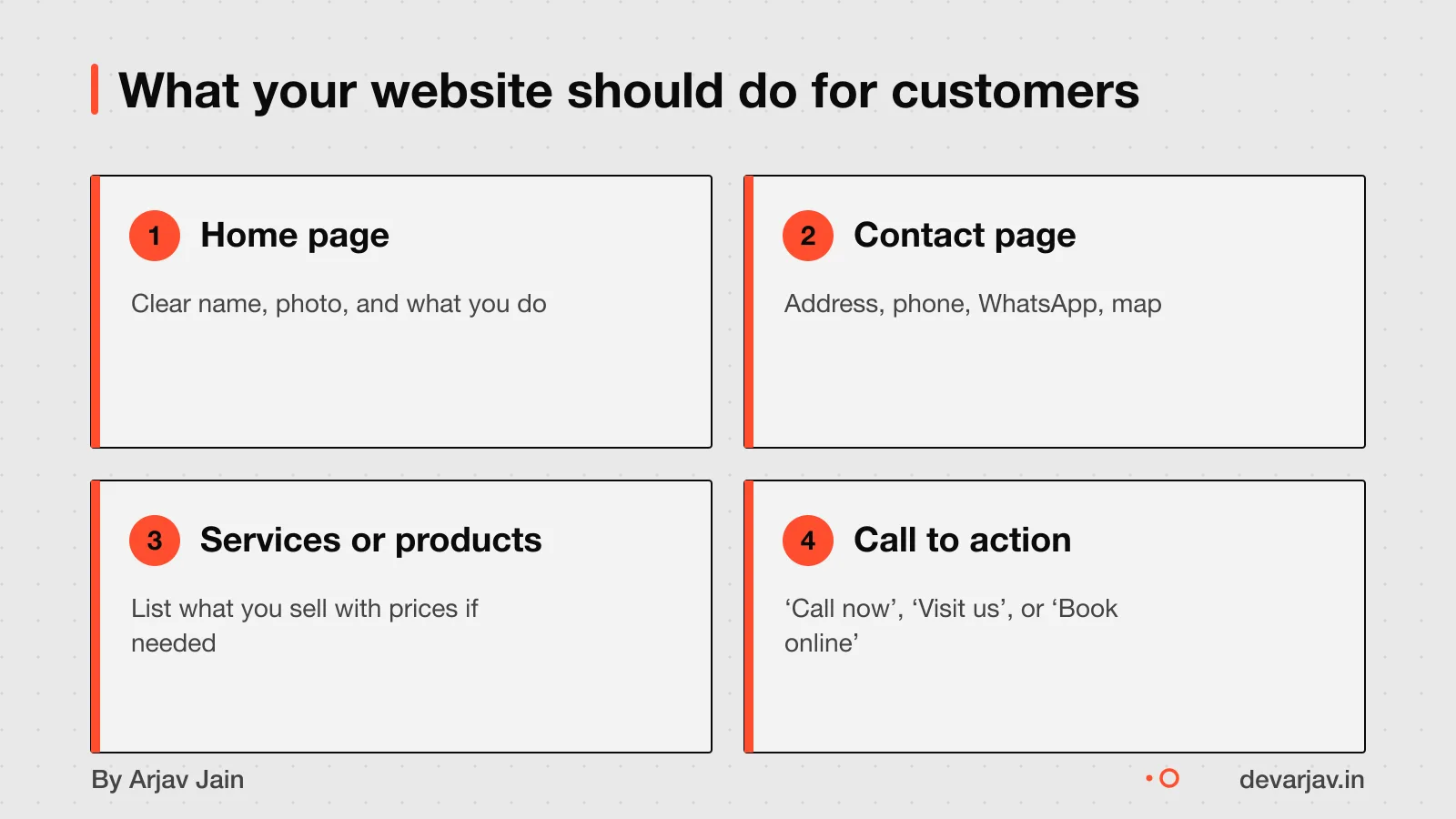
A small business website should clearly show your products or services, contact details, and location. It should work well on phones.
Your website should make it easy for visitors to understand what your business offers and what to do next. For example, a clinic website should list doctor availability, fees, and a one-tap call button. A coaching centre can show batch timings, faculty, and a sign-up form.
A simple, fast website builds trust and brings more customers. If you sell on WhatsApp or Instagram, your website still helps new customers find you.
How much does a small business website cost and what affects the price?
A basic website with 5 to 10 pages costs ₹10,000 to ₹20,000. You pay more if you want custom design work or more pages. A short corporate site with 10 to 12 pages costs ₹20,000 to ₹50,000.
Extra costs will come up. You must pay for a domain name each year. This costs ₹800 to ₹2,000. Hosting, security updates, and content creation are other hidden costs. Some developers charge extra for these. Ask for a full list before you agree.
Design and pages affect the price. A simple design with standard colours and fonts is cheaper. Custom layouts, animations, or brand-specific graphics cost more. Each extra page adds time and effort. A site with 5 pages costs less than one with 15.
For a full breakdown of what each cost covers, see What does a small business website cost?.
Want a number for your idea? Send one line on WhatsApp. I reply with what drives the cost and what to cut.
Message me on WhatsAppFreelancer, agency or solo developer, who should I hire?
Hire a freelancer if your project needs just one person to build a simple website. This gives you lower cost and direct control, as you talk to the developer yourself with no middle layer. For example, a clinic website with doctor details, timing and contact form can be done by one skilled person.
Choose an agency if you need a team for design, content, development and marketing all at once. Agencies bring more roles under one roof, but you may pay more and lose direct touch with the actual builder. For instance, a multi-location shop chain launching online with SEO and ads may need team support.
A solo developer who works independently, like me, is a middle path, you get technical skill without agency markup, and clear communication without jargon. You keep control, know who is building, and can ask changes directly. But you must provide clear input and review work in steps.
The trade-off is cost versus coverage. Freelancers and solo developers cost less but expect you to coordinate extras like content or logos. Agencies cost more but may include those. For most small shops, clinics or coaching centres, a single skilled developer is enough if they explain well and show past work.
How to hire a developer when you are new to tech, this guide helps you talk clearly and avoid confusion.
What are the risks of hiring the wrong developer?
A bad developer can leave you with a broken site, lost money, or a website you cannot change. If the site does not work on phones, looks unprofessional, or loads slowly, customers may not trust your business. You could lose money if the developer stops replying or vanishes before finishing the work. Under Indian contract law, you can only enforce a deal once the work is done or a clear milestone is reached. If the developer disappears, the contract may become void if completion becomes impossible. You may not be able to update the site later if the developer keeps control of the login, code, or domain. Always insist on full ownership and access before paying the final amount. For example, a clinic owner in Indore paid ₹18,000 for a site. But could not add new doctors because the developer never handed over the admin login.
How do I check if a developer is good and what should I say first?
Ask to see real websites they have built for small businesses like yours. A good developer will show you live links, not just pictures or mockups. Visit those sites on your phone to check if they load fast, look clear, and make it easy to find contact details or services. Squarespace has a collection of websites made by real users.
Can they show you a site for a clinic, shop or coaching class in a smaller town? That proof matters more than work for big companies. If they cannot share any, that is a red flag. You want someone who understands local needs, like phone-first design and simple updates.
In your first message, say your name, type of business, and what you want the website to do. For example: "Hi, I am Raj, I run a tailoring shop in Bilaspur. I want a simple website with my address, phone number, and photos of my work." This helps the developer give you a clear reply, not a sales pitch.
Have a quote in hand? Send it to me and I will mark what is missing.
Message me on WhatsApp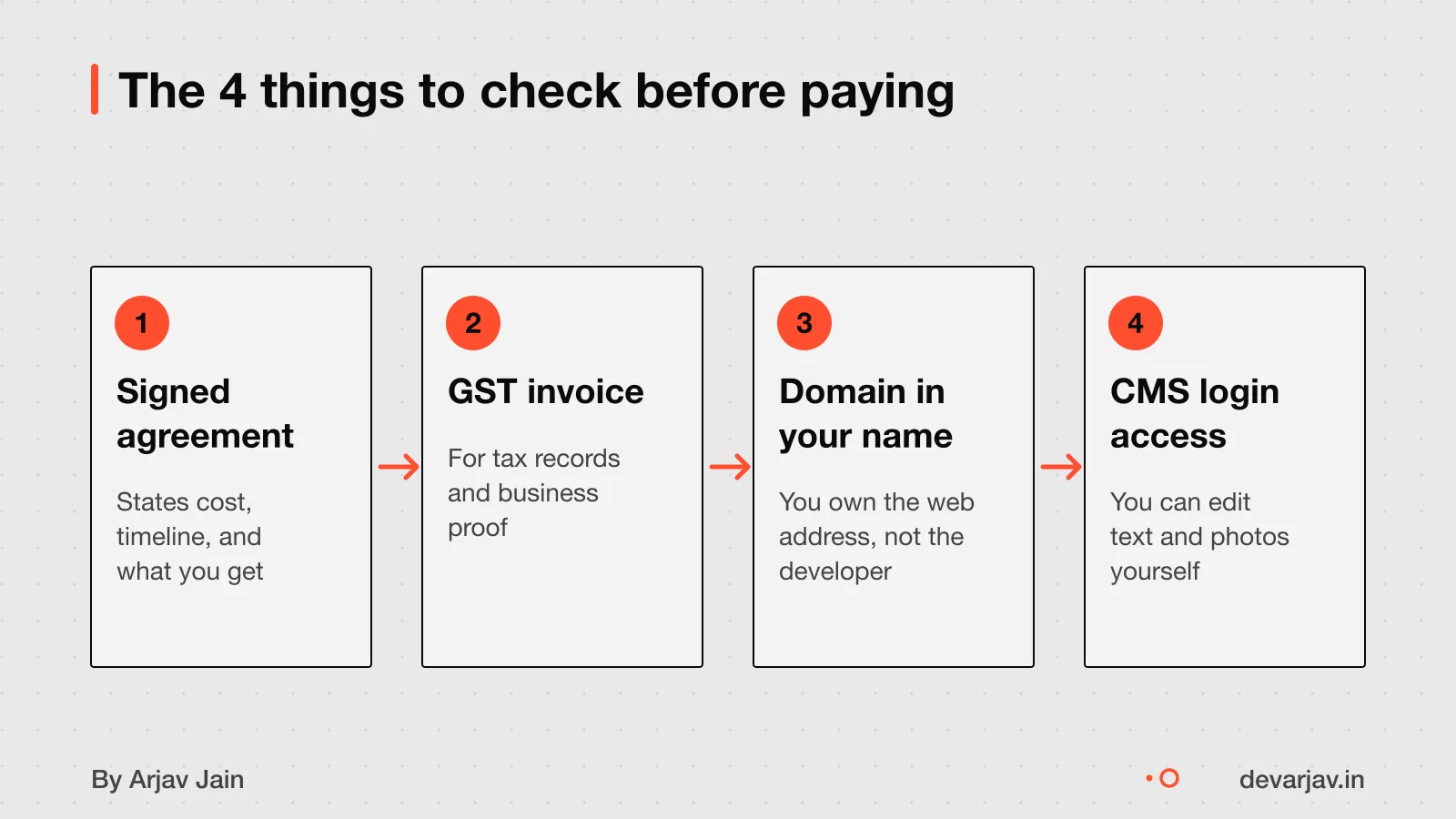
Who owns the website after it is built?
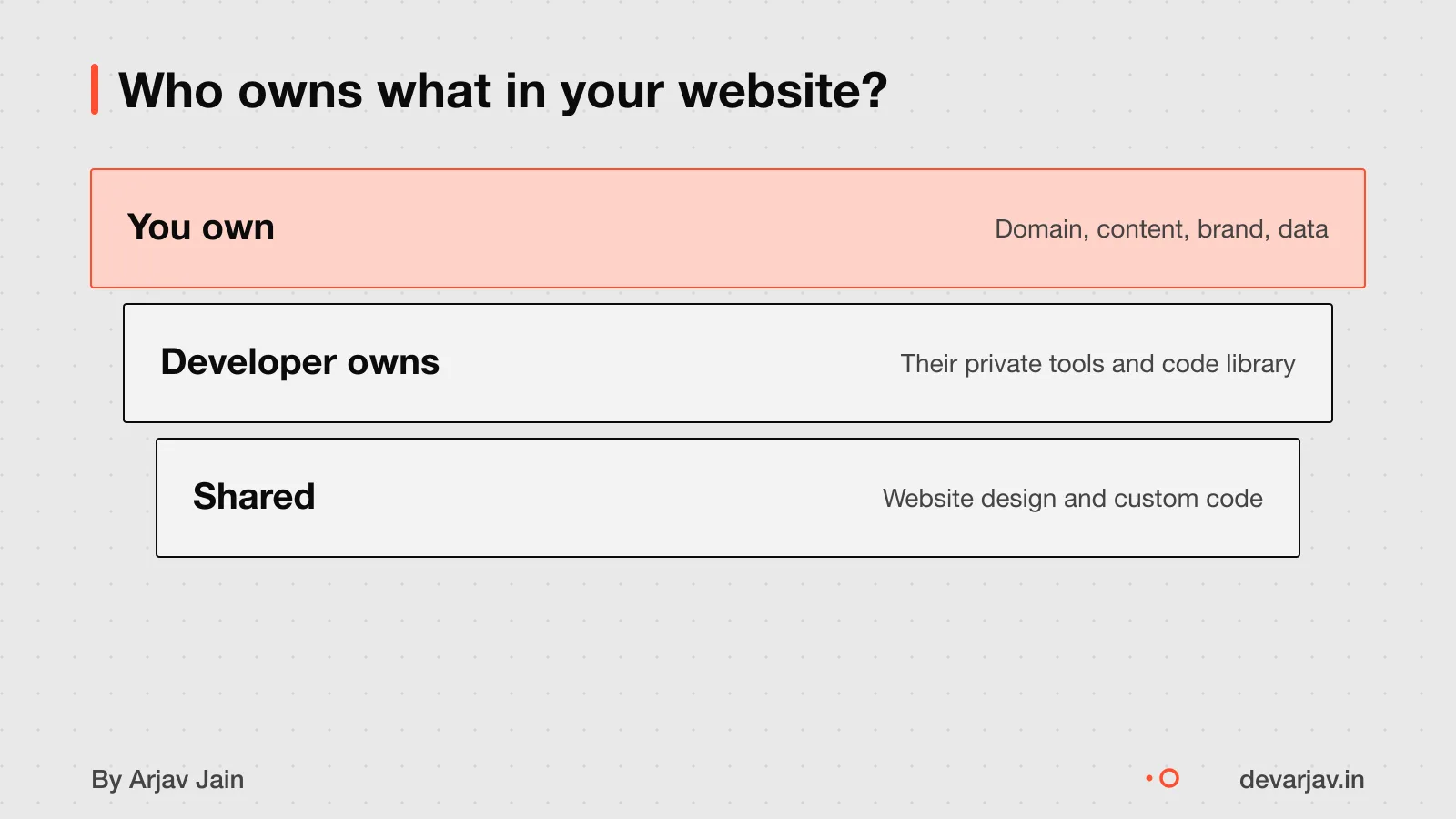
You should own both the domain name and the website code. The domain is like your shop's address, it must be in your name so no one can block you from it. You can move the site to another developer anytime, just like hiring a new electrician for your shop. If the original developer stops working, you still keep full control.
A developer should not lock you into their services. Under Indian contract law, no one can stop you from hiring another person to do the same lawful work. This means you are free to switch developers later. But check who holds the domain registration, if it is under their name, ask them to transfer it to you before launch.
Think of it like renting a shop versus owning it. If you rent, the landlord controls the keys. If you own, you control everything. Your website should be owned by you, not rented from the developer. This way, you can update it, move it, or hire someone else without asking permission.
How to hire a developer in India
When this advice does not apply to you
When this advice does not apply to you
You can use a website builder instead if your needs are very simple. Tools like Hostinger AI Builder let you create a basic site through prompts without writing code. This works well if you only need a few pages and do not plan to add new features later.
You should avoid hiring anyone if you are not ready to spend time or money. If you cannot describe what your business does or what you want online, wait. Work it out first.
Build your site in-house only if you already have someone on staff who knows web tools and has time. For most small shops, clinics or coaching centres, this is not the case.
Next step: message me on WhatsApp with what you want to build. No forms, no sales team.
Message me on WhatsAppThe chapters
A protective, step-by-step guide for a first-time buyer. It takes about ten minutes and can save you months.
10 min read, in 6 chapters.
01 · Start here
Write what you need, in one page
Most hiring problems start before the first conversation. If you cannot say who the product is for and what they will do with it in two sentences, no developer can price it, and every quote will be a guess.
Write one page: who it is for, the problem it solves, the three things that must work on day one, and two or three apps you like. You do not need designs or a feature list. Working out what to leave out is part of the job you are hiring for.
Do this One page. Three must-haves. No more.
02 · Decide
Choose the kind of help
There are three common shapes: a freelancer, a small studio, and a larger agency. A freelancer is usually the fastest and most direct for a clear, small scope. A studio gives you a few people with complementary skills. An agency carries process and breadth, at a price.
A fourth option is hiring in-house, which only makes sense when software is the core of your business and there is work for years.
Do this Ask who exactly writes the code, whichever you pick.
03 · Find
Find and shortlist three
Look where proof is visible: shipped apps in the stores, a portfolio with real names, a profile with a history of work, and people your own network can vouch for.
Shortlist three, not ten. Three conversations are enough to see how people differ in how they ask questions.
Do this Prefer people who ask about your users before your budget.
04 · Verify
Verify before you trust
Open two shipped apps on your own phone. Ask them what they would defend in that app and what they would change. Speak to one previous client, by phone.
A portfolio of screenshots proves nothing by itself. A shipped, running app and someone willing to be called is a different level of evidence.
Do this Call one past client. It takes ten minutes.
05 · Agree
Put it in writing
A fair agreement states: what is included and what is not, milestones with something you can test at each one, how changes are priced, who owns the code and accounts, and what happens if either side stops.
Make sure the repository and the Apple and Google store accounts are created in your name from the start. It is the single easiest thing to do and the hardest to fix later.
Do this If it isn't written down, it isn't included.
06 · Finish
Pay, test and take it over
Pay against milestones you have tested, not against time passing. At the end, you should receive the source code in your repository, the accounts and keys in your name, and a short document on how it fits together.
Plan for the first month after launch. Bugs show up when real people use real data, and it helps to know in advance what fixing them costs.
Do this Keep one backup of everything, somewhere you control.
Quick answers
How much should I pay up front?
Tie payment to milestones you can test. A small first payment to start is common, but avoid paying the whole amount before you have seen working software.
Do I need a technical co-founder?
Not to build a first version. You do need someone technical to ask hard questions of your vendor, which can be a paid hour with an independent advisor.
Questions people ask
What should I check before paying a developer?
Check that you own the domain name and have access to the website CMS. Sign a simple agreement that states the work, cost, and timeline. Make sure the developer will issue a GST invoice. These steps protect your business and ensure you can update the site later.
How do I know if a developer is charging too much?
Compare the quote to market rates. A basic website with 5-10 pages costs between ₹10,000 and ₹20,000. A short corporate website with 10 to 12 pages costs between ₹20,000 and ₹50,000. Ask for a cost breakdown to see what each part includes. Use our cost page to check current ranges.
Should I pay full amount upfront?
No. Pay in stages. The developer should only get each part after completing that stage. This protects you if they stop working. An agent must pay sums received for the principal. Do not hand over full payment before the site is live.
What legal agreement should I use?
Use a simple written note that lists the work, cost, timeline, and that you own the final website. Avoid any clause that restricts your right to run your own business. The agreement must not have unlawful terms, or it is void. Check this for your case with a lawyer.
Can I update the website myself later?
Yes, if it uses a CMS like WordPress or Wix. These let you edit text and images without coding. Ask the developer to give you login access. Website builders are suitable for beginners and small teams. Then you can change prices, offers or photos anytime.
What if the website does not work on mobile?
Test the site on a phone before launch. Most visitors in India use mobile devices. A good website makes it easy for visitors to know what you offer and what to do next. Reject it if it fails on phones.
Is GST charged on website development?
Yes, GST applies to website development services in India. You should get a proper invoice with GST details to claim input credit. Ask the developer to include their GSTIN and the correct HSN code. Check our cost page for the latest GST rules and invoice samples.
What if the developer stops responding after payment?
You must own the domain and hosting accounts. If the developer vanishes, you can still move the site to another developer. Use a checklist before paying so you keep control. Regular maintenance can lead to better performance and long-term cost savings. Protect your business from delays.