What is a grocery delivery app?
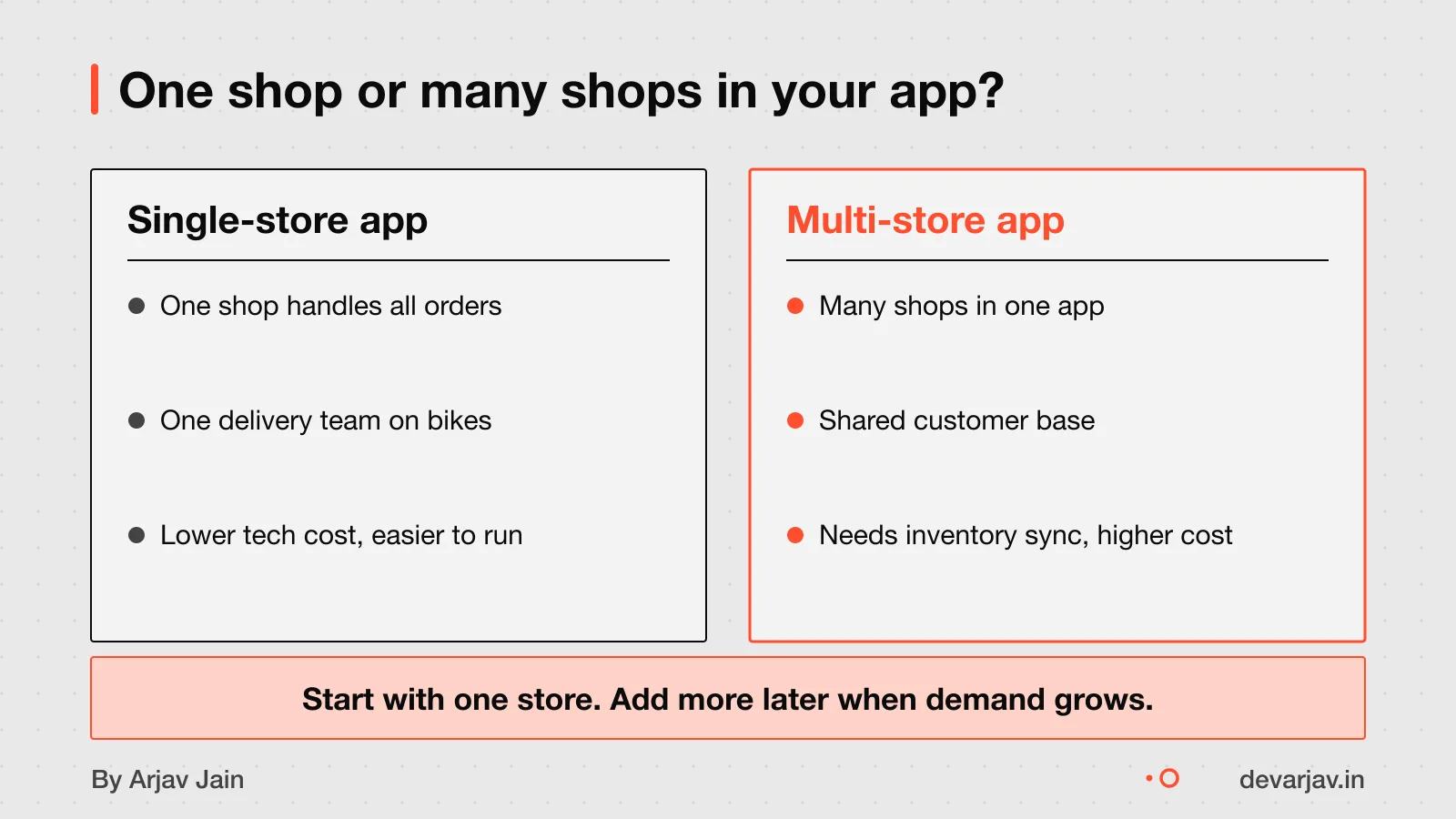
A grocery delivery app lets your customers order groceries from your shop and get them delivered. It is different from a basic online store because it includes delivery tracking, driver coordination, and order status updates in real time. You can build it for one shop or link it to many stores later. Some apps serve only your inventory, while others act as an aggregator that lists multiple local stores. There are also specialty apps focused on organic, vegan, or gourmet items. Most small kirana stores start with a single-store app to keep costs low. If you grow, you can add more stores later. Think of it like starting with your own counter, not a whole market.
You can compare a custom app vs platform to see which fits your business.
What features add the most cost?
The biggest cost jumps come from complex features like real-time inventory sync, delivery tracking, and multi-store support. These require more coding, testing, and integration with hardware or third-party services. For a sweet shop in Varanasi, live tracking may cost ₹45,000 as an estimate, assuming SMS and push alerts at each delivery stage.
A web portal for shop owners to manage orders and stock ranges from $5,000 to $25,000. This is because it needs secure login, data dashboards, and live updates. Most small shops can start without it by using a shared tablet or laptop with the app itself.
Delivery tracking raises cost because it needs GPS sync, status triggers, and message automation. The app must update customers via SMS, email, or push notifications at every step. Simple alerts like "order confirmed" or "out for delivery" cost less than $5,000.
You can cut cost by delaying non-essential features. Start with order entry and phone-based updates. Add automated tracking later when order volume justifies it.
must-have vs later features
Want a number for your idea? Send one line on WhatsApp. I reply with what drives the cost and what to cut.
Message me on WhatsApp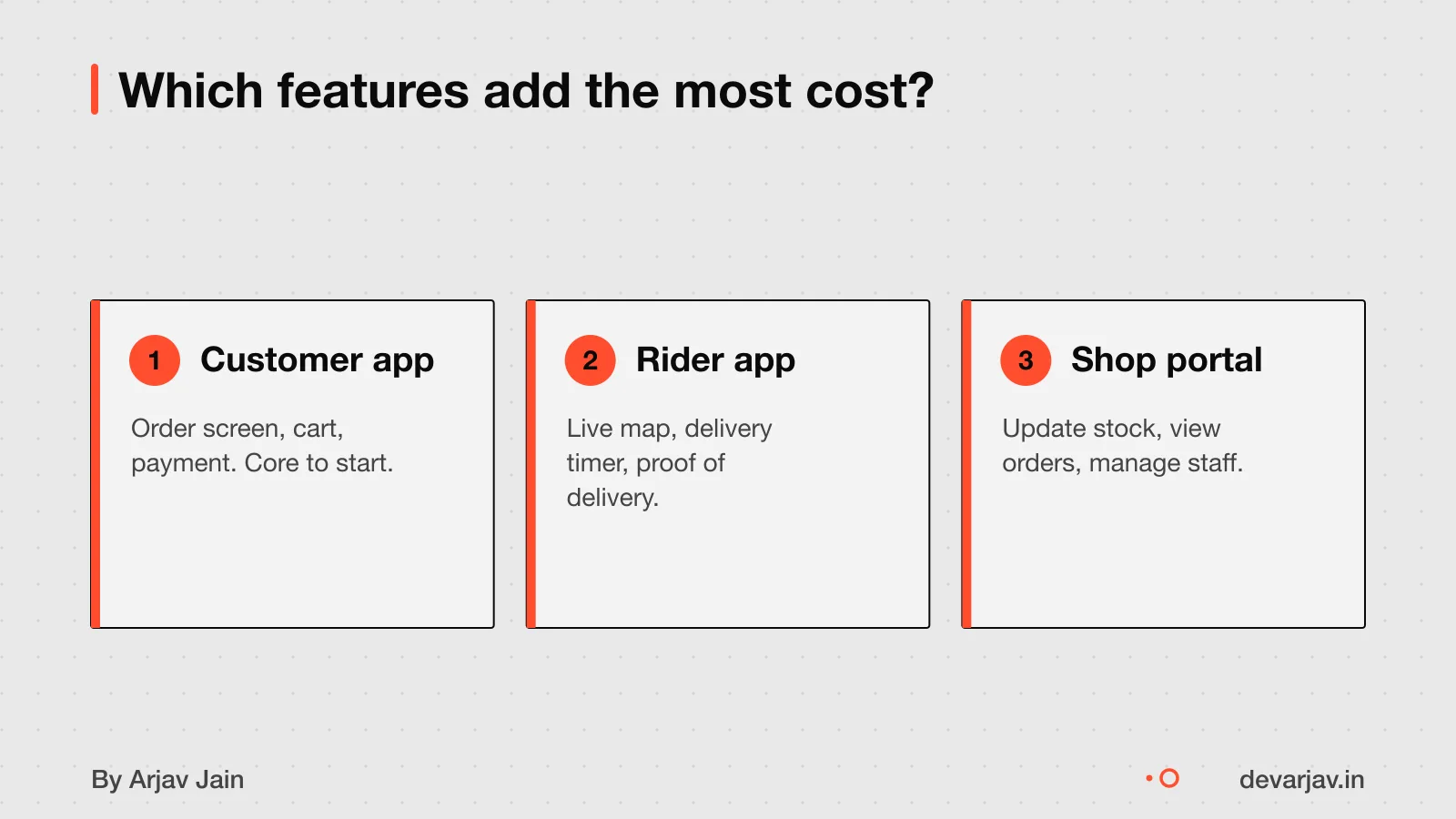
How long does it take to build?
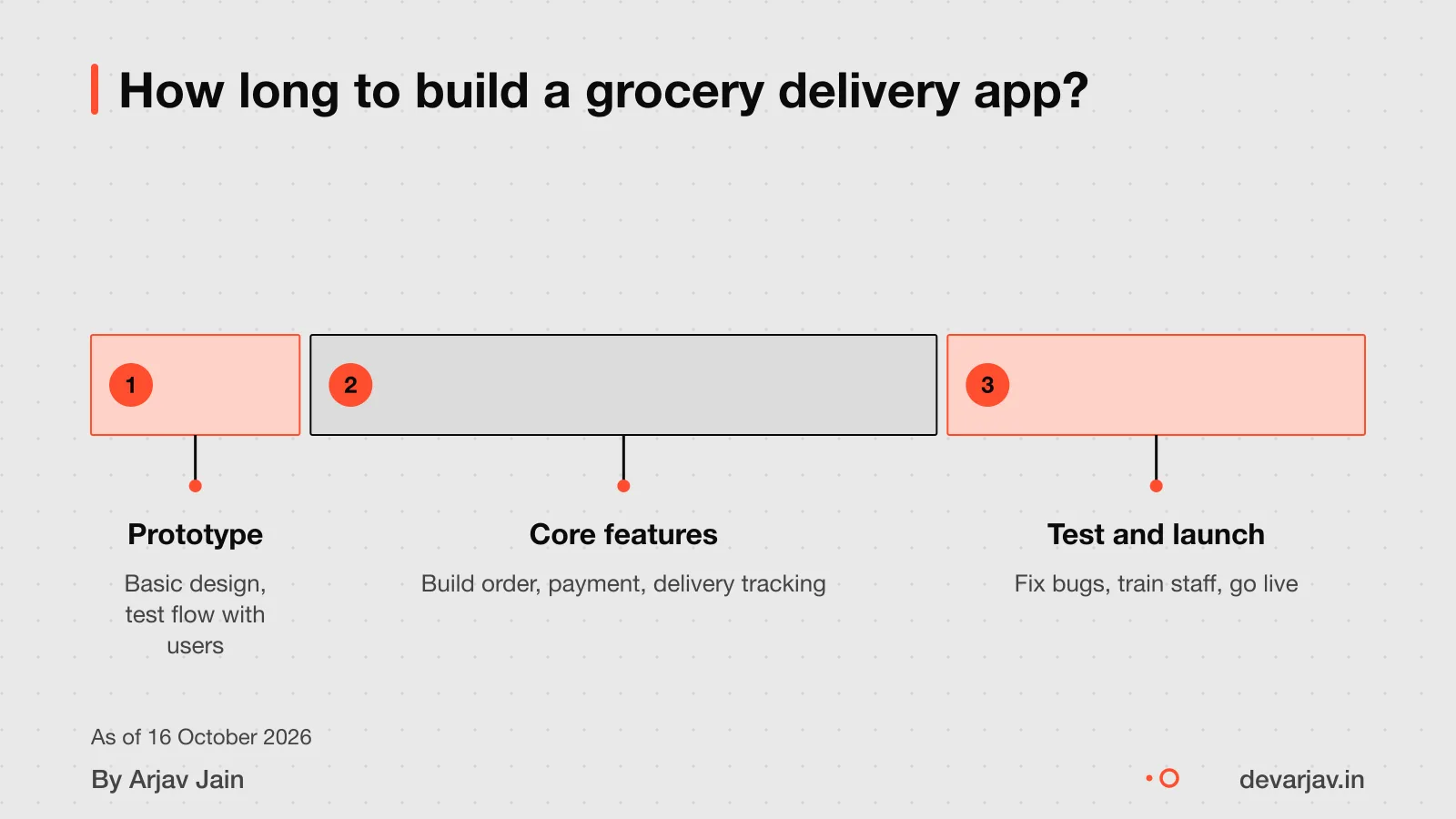
A basic grocery delivery app takes 4 to 6 weeks. This includes listing items, cart, checkout, and order tracking. It assumes one delivery area and no real-time stock sync.
Adding features like payment integration, user login, or multiple stores adds time. A mid-level app with payments and authentication takes 8 to 10 weeks. A complex app with live inventory, delivery tracking, and admin panels for staff takes 12 to 20 weeks.
You can get a working version faster. A clickable prototype takes just 2 to 3 weeks. It looks like a real app but does not connect to live stock or payments. Use it to test your idea with customers before full build.
For planning, see the full timeline by feature.
Freelancer, agency or solo developer?
A freelancer is one person who usually works in one or two areas, such as design or coding. An agency gives you a full team, designers, developers, project managers and testers, with a clear process. A solo developer, like me, works alone but may partner with others for design or QA when needed.
For a small budget, a freelancer or solo developer is often best. Typical project budgets for freelancers range from $2,000 to $15,000. Agencies usually cost more due to overhead and team size.
But choosing only on low price is risky. A $4,000 build that fails and must be redone for $25,000 later is not a saving. You may face hidden costs from poor code, missed features, or no support after launch. Pick someone who explains trade-offs clearly, not just the lowest bid.
What are the ongoing costs?
Maintenance is charged, but the annual rupee rate is not known. As an estimate, assume 15% to 25% of the build cost. Yearly maintenance could be around 15% to 25% of the app development cost for the first year after deployment. This covers bug fixes, security updates, and compatibility with new phone versions. It does not include adding new features or marketing.
If you later transfer the app to another developer, Google Play charges a one-time fee of US$25 to change the developer account. This fee is set by Google, not your developer. You should confirm with your developer what their maintenance plan includes. Ask if they charge extra for updates or support.
What are the biggest risks?
Last-mile deliveries cost so much because they make up 53% of total shipping expenses. This is the final leg from your store to the customer’s door, often done by a rider on a bike. It includes fuel, time, and coordination. For a small shop, this can eat into profits fast, especially for short-distance or low-value orders.
Delivery fees must be clear upfront. If customers see unexpected charges at checkout, 90% will leave without paying. This means your app must show all fees, delivery, packaging, or service charges, before the cart is final. Hiding them risks losing almost every order.
One failed delivery hurts your business. About 23% of customers will not come back after a single missed or wrong delivery. They may switch to a rival shop or use a bigger platform like BigBasket. Trust is hard to win and easy to lose.
These risks are highest if you promise fast delivery without testing your rider network or. If your app does not update delivery status in real time.
Not sure if your project has this risk? Tell me the plan in two lines and I will say yes or no.
Message me on WhatsAppWhat legal rules apply?
Yes, you need an FSSAI license if you sell packaged or prepared food. The license type depends on your annual turnover. Talk to a CA about your GST claim. Not all expenses qualify, and record-keeping must be correct.
FSAAI and GST for medicine delivery covers compliance for a similar food-adjacent app.
Who owns the app and can I switch developers?
You own the app’s code once you pay for it, unless your contract says otherwise. This means you can move it to another developer if you need changes or support later. Most software contracts in India for custom apps give full ownership to the buyer.
You can switch developers at any time. The new developer will need access to the source code, app store accounts, and any third-party services. Make sure you get all login details and code files when the project ends.
You can also transfer the app on Google Play to a different developer account. To do this, you need the registration transaction ID for both your account and the new account. Once transferred, all users, ratings, comments and order data move with the app.
Always keep a copy of the source code and your app store credentials. Do not let any developer hold them hostage. If they refuse to hand over the code, you can take legal action under Indian contract and IT laws. For your case, talk to a local lawyer.
Worked example: App cost for a single-store shop
Worked example: App cost for a single-store shop
As an estimate, a basic grocery delivery app with 40 screens and one payment gateway costs ₹5 lakh. This assumes a simple order flow, no real-time inventory sync, and delivery tracking through manual updates. The estimate comes from converting the US$15,000 to $30,000 range for a simple MVP using a rate of ₹83 per dollar. Converting $15,000 to $30,000 at ₹83 per dollar gives ₹12.45 lakh to ₹24.9 lakh. ₹5 lakh is a lower-end estimate based on India-adjusted rates for a lean build.
Year one maintenance may cost 15% to 25% of the build cost. The exact annual rupee cost is not known and may vary by developer.
Additional costs include a one-time transfer fee of US$25 if you create a new target Google Play account. Other charges like hosting, third-party APIs, or marketing are not included. You may also need to pay for an FSSAI license if you sell packaged food, but the fee depends on your turnover.
Assumptions: - Development cost is based on a simplified MVP and India-adjusted rates. - Maintenance is a percentage of build cost, not a fixed annual rate. - Payment gateway integration (e.g., UPI) is included, but the exact cost to add it is not known. - The app is for one store with no multi-store or rider app features. - You provide product images, pricing, and basic content during development.
When this advice is wrong
When this advice is wrong:
- If you get fewer than 50 orders a day, a custom app may cost more than it saves. Delivery platforms like Dunzo or Swiggy Stores charge commission but need no upfront cost. As an estimate, if Dunzo charges 18% commission, you need about 1,000 orders per month to justify a ₹5 lakh app over 2 years.
- If your area has strong local delivery apps or national players like BigBasket or JioMart, building your own may not add value. Use them instead until you outgrow their limits.
- If you cannot update product prices or stock in real time, an app may show wrong info and upset customers. Fix your back-end first.
- If you rely on cash payments and have no digital records, the app may become a burden. Start with a WhatsApp or phone-order system first.
Related reading: custom app vs platform.
Next step: message me on WhatsApp with what you want to build. No forms, no sales team.
Message me on WhatsAppAssumptions behind the numbers
- Assumption: Built in Flutter for Android and iOS
- Assumption: One shop, no real-time inventory sync
- Assumption: No rider app or delivery tracking
Work out your own number
Here is the cost breakdown for a grocery delivery app for one small shop. Adjust the sliders to see how the price changes.
Your working total
₹4,40,00011 weeks × 2 people × 5 days × ₹4,000- Scope and design18%
- Build55%
- Testing and fixes18%
- Launch and stores9%
The weeks shown are an example of a small app, there to be changed. Fees you pay others (store accounts, cloud, SMS) are not in this total.
What moves the price
- Adding rider app
Not known. Estimate depends on real-time location and task assignment.
- Inventory sync
Not known. Real-time stock updates add complexity.
- Delivery slots
Not known. Time-based logic adds design and testing.
- One platform first
Start with Android or iOS to cut cost in half.
- Using ready-made tools
Tools like Firebase reduce custom backend work.
- Clear scope upfront
Avoiding changes during build saves weeks.
Fees that go to someone else
Google Play transfer fee
₹2,000 to move the app to another account.
Cloud, SMS, maps, payments
Paid directly to providers based on usage.
App maintenance
Not known. Typically 15% to 25% of build cost yearly.
Ask for these before you sign
- What features raise the cost the most?
- Can I start with fewer features and add later?
- Who pays for cloud hosting and SMS?
- Is maintenance included in the price?
- What is not included in this estimate?
Questions people ask
How much does a grocery delivery app cost to build?
A basic grocery delivery app costs between US$15,000 and $30,000. A mid-level app with payments and authentication costs between US$30,000 and $60,000. As an estimate, assuming mid-level features, the cost could reach ₹4.5 lakh.
Why does the cost go up so much for some apps?
The biggest cost jumps come from features like a rider app, real-time inventory sync, and delivery time slots. These need more coding, third-party tools, and testing. The exact extra cost for each is not known.
How long does it take to build a grocery delivery app?
A basic app takes 4 to 6 weeks to build. A mid-level app with payments and user accounts takes 8 to 10 weeks. Complex versions can take up to 20 weeks.
What is the cheapest way to start?
Start with a minimum viable product using cross-platform tools like Flutter. This can cut costs by 20% to 40% compared to building two separate apps. Delay non-essential features like chat or dark mode until later.
Do I need to pay GST on app development?
Yes, you must pay GST on app development fees if the developer is in India. If you are GST-registered, you may claim input credit. Check this for your case with a chartered accountant.
Can I use a ready-made platform instead?
Yes, platforms like Dunzo Local, Swiggy Stores, or Flipkart Supermart let you sell without building an app. They offer lower setup costs and reach more customers, but take a cut of each sale.
How do I avoid paying for unused features?
Define your MVP with only must-have features and validate demand first. Scope creep can add up to 15% to your budget. Avoid adding features like analytics or feedback systems too early.
What should I ask a developer before hiring?
Ask if they do a discovery session before quoting a price. Ask for proof of past work and clarify payment terms. Skipping these questions can cost $60K and 6 months.
Can I switch developers after the app is built?
Yes, you can transfer your app to a new developer. You will need the Google Play registration ID and active accounts. Make sure your contract gives you full ownership of the code.
Is it worth building an app for a small shop?
It depends on your order volume and delivery costs. The Indian online grocery market is expected to grow by 20% every year. Last-mile delivery takes 53% of shipping costs. Small margins can be risky.