What is an MVP, and how is it different?
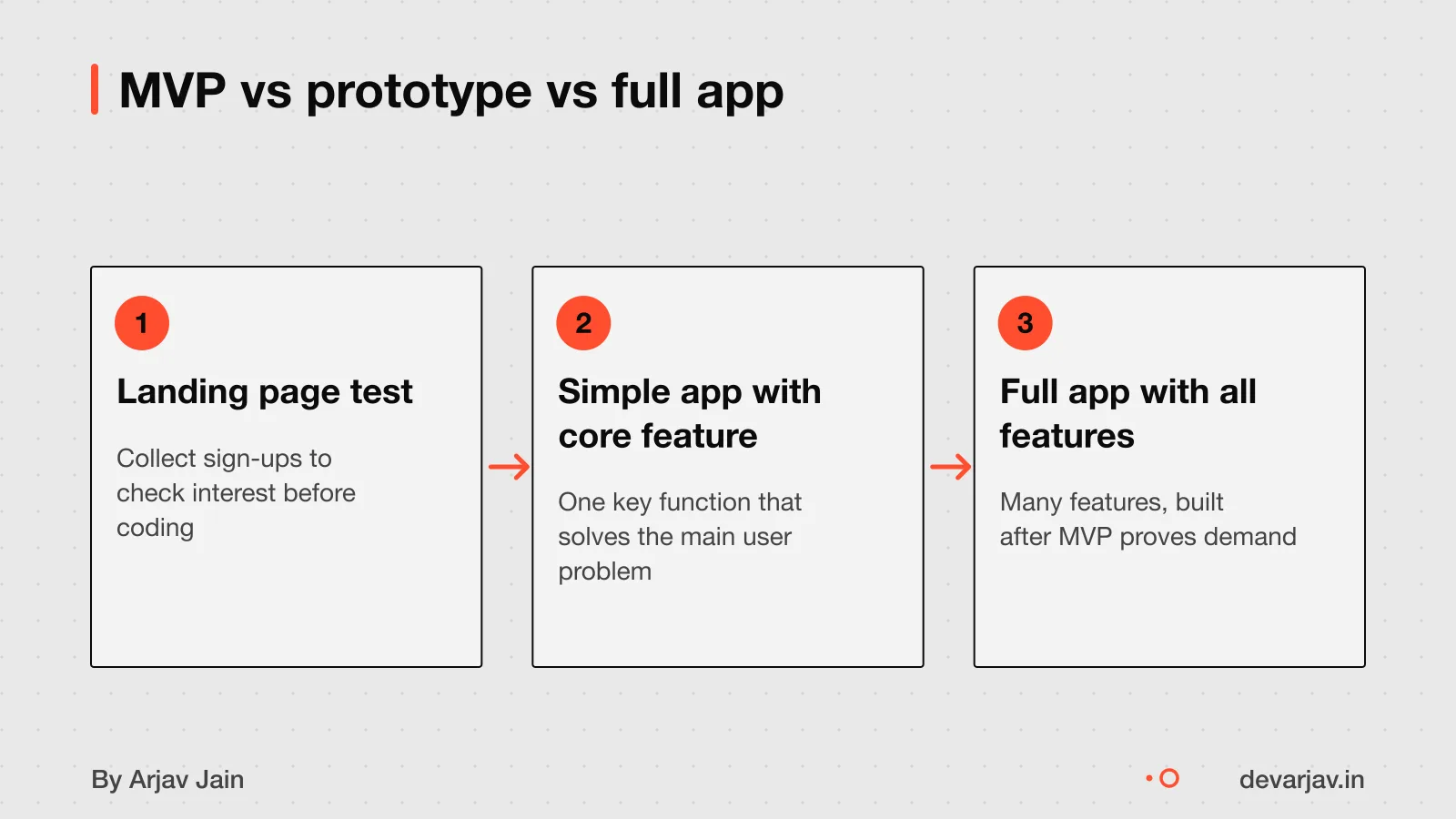
An MVP stands for Minimum Viable Product. It is the smallest working version of your idea that lets real users test your core business assumption. Unlike a prototype, which shows how something might work, an MVP is a real app that people can use. Unlike a full app, it does not have every feature you plan.
An MVP must solve one core problem for your target user. For example, a clinic booking MVP should only let patients book slots and doctors confirm them. It does not include payment, medical history, or reminders.
Its goal is not to look perfect but to answer: "Will people use this?" You learn fast and cheap before building more. A prototype may look real but cannot test real behaviour. A full app takes longer and costs more, with risk you build features no one needs.
What MVP means in plain words
Do you really need an MVP, or can you test without code?
You can test your idea without writing code, saving time and money. A landing page or manual service can show demand before building an app. This works if your goal is to check interest, not deliver a digital product yet.
Cheaper ways to test include a landing page with a sign-up form and ads to measure interest. As an estimate, a landing page test costs around ₹20,000.
A landing page is enough when you need to validate demand for a service. Such as a local clinic booking slot or a new delivery menu. If people sign up, you know there is interest. Use What a small business website costs to plan your page.
You should skip the MVP and build manually when the service can be run by hand at first. For example, a food delivery idea can start with WhatsApp orders and a shared spreadsheet. This helps you learn pricing, timing, and customer pain points without code. Manual testing works best when speed and real feedback matter more than automation.
What parts of an MVP add the most cost?
The biggest costs in an MVP come from backend development, complex features like payments or AI. Hiring specialists such as DevOps or AI developers who charge more. Backend work often costs between $10,000 and $150,000, making it the most expensive part. This includes setting up databases, user authentication, and APIs that power your app. Frontend development follows, ranging from $10,000 to $125,000, to build the screens users interact with. UI/UX design adds $5,000 to $50,000, depending on how many screens and how polished they need to be. QA and testing can add another $5,000 to $50,000 to catch bugs before launch.
AI or large language model (LLM) features raise costs. Because developers with this skill command a 25 to 40 percent premium over others at the same level. For example, adding AI to summarise customer queries or draft replies will cost more in both time and hiring. DevOps or cloud setup (like AWS or GCP) also adds a 20 to 30 percent premium for specialists who manage servers, deployment, and scaling. These roles are not always needed in the first version, but. If your MVP needs high uptime or handles sensitive data, you may need them early.
You can cut costs by using cross-platform tools like Flutter or React Native. These let one team build for both Android and iOS at once, avoiding the extra cost of building two separate native apps. As a result, you save on development and testing time. For most small businesses, this is a smart move. What a Flutter app costs explains how much you can save with this approach.
Want a number for your idea? Send one line on WhatsApp. I reply with what drives the cost and what to cut.
Message me on WhatsApp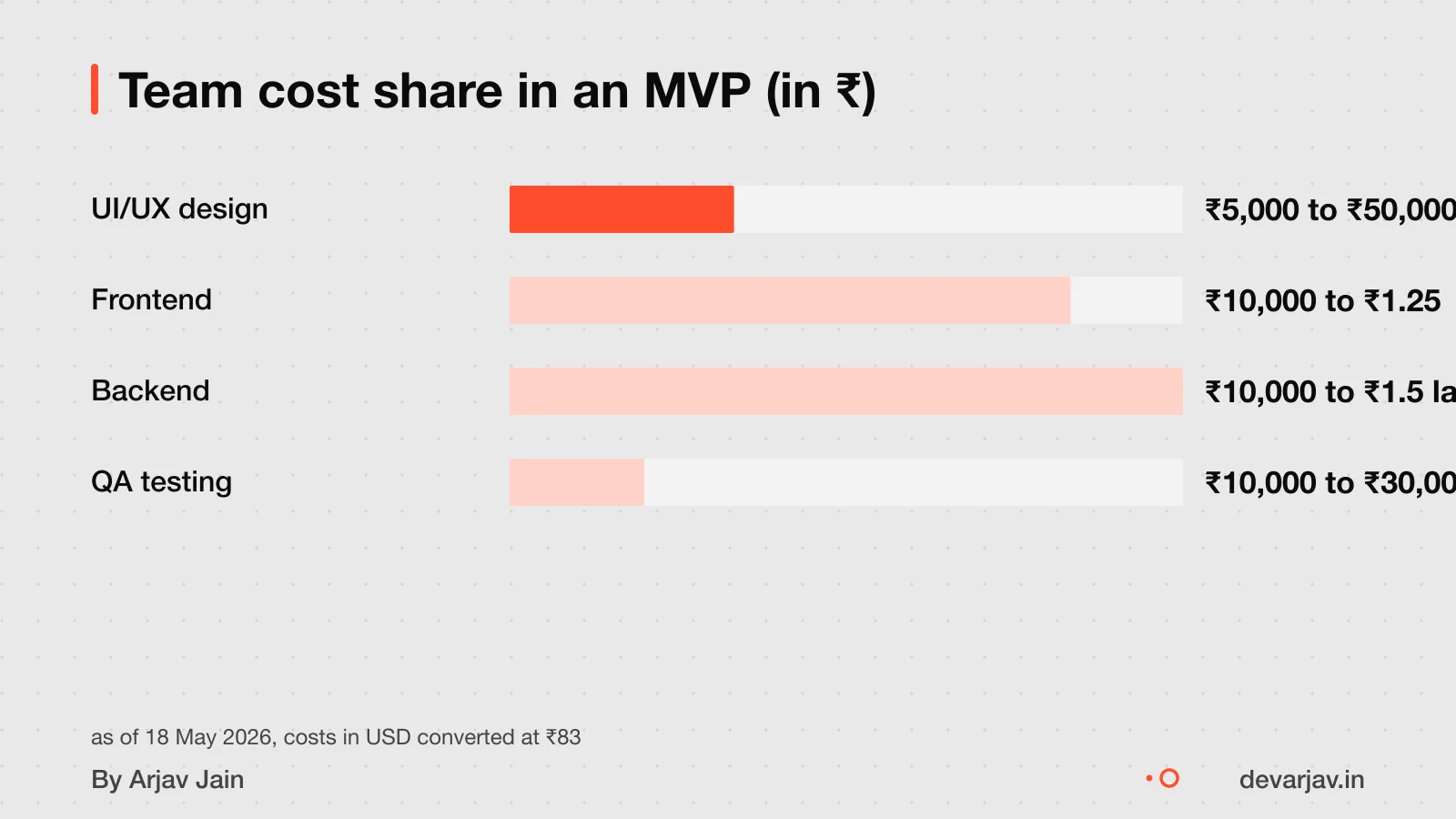
How long does it take to build an MVP?
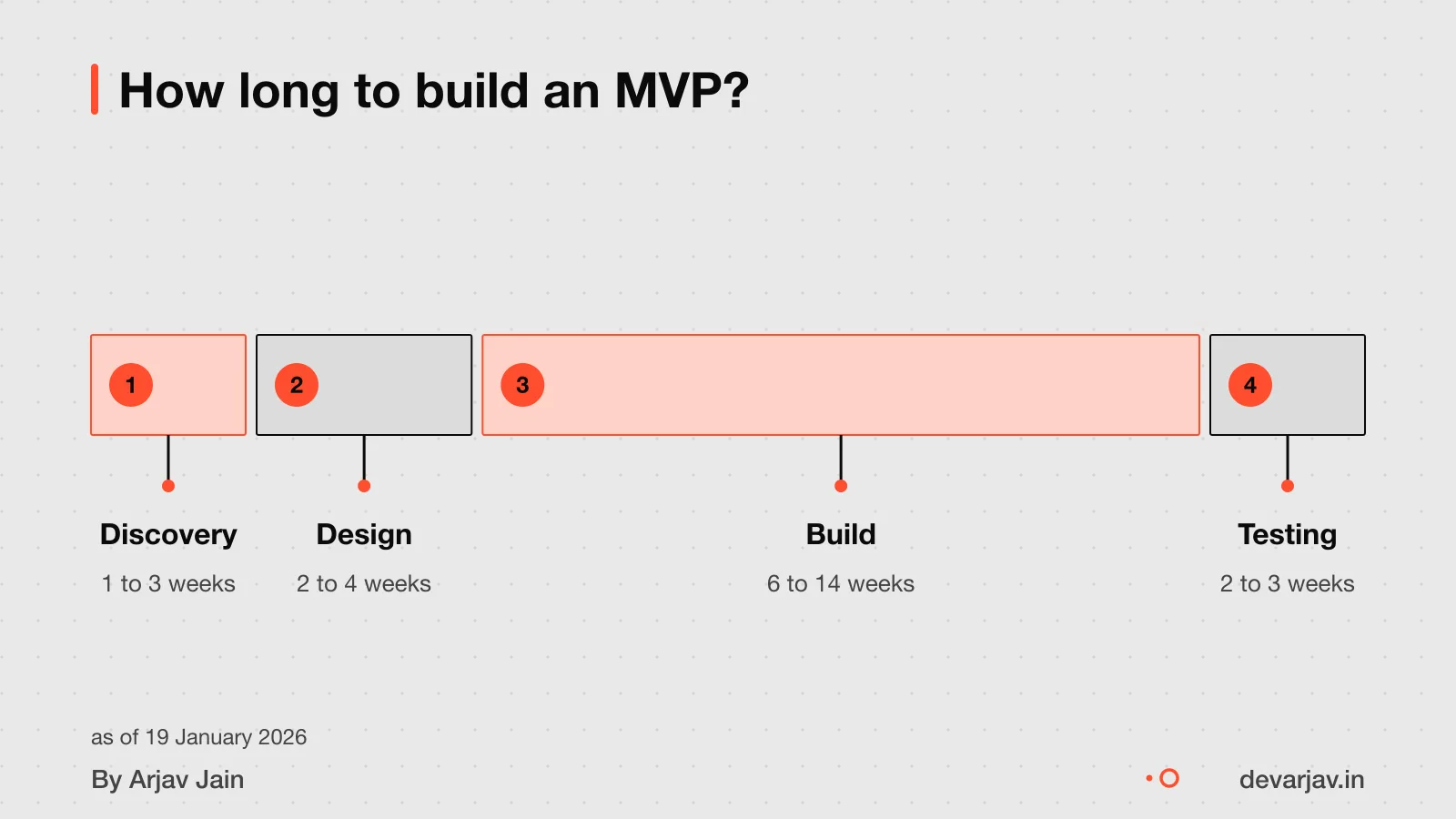
A simple MVP takes 4 to 8 weeks, a medium one 8 to 12 weeks. A complex MVP 12 to 20 weeks or more. The timeline depends on how many features you include and how quickly you make decisions.
The process has four phases: discovery, design, build, and testing. Discovery takes 1 to 3 weeks to finalise your core idea and user flow. Design takes 2 to 4 weeks to create screens and navigation that feel clear and easy to use. Building the app takes 6 to 14+ weeks, depending on complexity. Testing takes 2 to 3 weeks to catch bugs and check performance.
The biggest delay comes from adding too many features early. Founders often want to include "nice-to-have" functions, but that slows down the timeline. Hiring in-house can also delay start by 8 to 12 weeks or more. To stay on track, focus only on what you need to test your business idea.
If you are choosing a developer, check their process for speed and clarity. How to choose the best app development company explains what to look for in a team.
What are the steps in building an MVP?
Before coding starts, you must validate the problem by talking to 10 to 20 potential users directly. This confirms the issue is real and painful enough that people will change their habits to solve it. For example, if you run a clinic, ask patients what frustrates them most about booking appointments.
During development, focus only on the core user action that proves or disproves your business hypothesis. Build just enough to let real users perform that one action. If your idea is online booking, let users pick a slot and get a confirmation, nothing more.
After launch, decide whether to double down, pivot, or stop based on how users behave. If many patients book and show up, double down and add features. If they book but don’t come, pivot, maybe reminders are the real need. If no one books, stop and try a different idea.
These steps keep your MVP lean, fast, and focused on learning, not building.
Legal, tax, and ownership: what your contract must say
You pay 18% GST if your developer’s annual income is over ₹20 lakh. This tax applies to their invoice and is standard for Indian clients. Your contract must state this clearly to avoid surprise costs.
The Copyright Act, 1957 and the Indian Contract Act, 1872 govern code ownership and enforceability. Under the Copyright Act, the developer owns the code by default unless your contract says otherwise. Ownership must be assigned in writing, specifying exactly which rights you receive.
Paying for development does not mean you own the code. Many founders assume payment transfers full rights, but this is not true under Indian law. Your contract must include a clear clause that assigns source code ownership to you.
You can move the MVP to another developer only if you have the source code and full IP rights. Some firms retain ownership or charge extra for handoff. As an example, Tibicle LLP offers full IP handoff at project close. Ask for the same in your contract to stay in control.
A well-drafted agreement protects you. It should cover IP assignment, source code delivery, and reuse rights. For your case, speak to a legal expert on tech contracts. What a maintenance contract should include
How much does it cost to maintain an MVP after launch?
You should plan to spend around 15% to 25% of your build cost for the first year to maintain your MVP. This covers updates, bug fixes, and minor improvements. For example, if your MVP cost ₹50 lakh to build, set aside ₹7.5 lakh to ₹12.5 lakh per year for upkeep.
Monthly cloud hosting costs ₹4,000 to ₹20,000, based on user traffic and storage needs. This range comes from converting $50 to $300 per month at current exchange rates. Costs rise as more people use your app or store data.
Agency support, if you hire one, costs $1,000 to $3,000 per month. This includes bug fixes, security patches, and small feature updates. Some charge a fixed monthly retainer, while others bill by the hour.
For a full breakdown of what affects yearly upkeep, see What app maintenance costs per year.
Worked example: a clinic booking MVP
A ₹1.5 lakh clinic booking MVP includes patient registration. It shows doctor availability and lets patients pick time slots. SMS confirmation is added. A basic admin panel lets you view bookings. This scope assumes one doctor and about 10 patients per day. No online payments are included. SMS-based reminders are used. The goal is to test if patients book and show up without manual follow-up.
The build takes 12 to 16 weeks in total. Discovery takes 1 to 3 weeks. You define the clinic’s workflow and patient journey. Design takes 2 to 4 weeks. Simple screens for booking and admin view are created. Development takes 6 to 14+ weeks. The app logic is built. It is connected to an SMS gateway. Testing takes 2 to 3 weeks. Bugs are fixed. Reliability is ensured.
The cost is driven by avoiding complex features. No payment integration keeps it simple. A pre-approved SMS gateway avoids custom telecom work. A single doctor’s schedule reduces backend logic. As an estimate, this ₹1.5 lakh cost assumes no Android and iOS apps. Just a mobile-friendly web app is used. If you add native apps or online payments, the cost rises.
This example fits a small clinic in a tier-2 town testing digital bookings. For a larger setup with multiple doctors or payments, see What a clinic booking app costs to adjust your budget.
When an MVP is not worth it: risks and bad fits
Building too much turns your MVP into a full product before testing demand. This raises costs and delays feedback. The biggest mistake is adding features that do not test your core idea. Each extra feature increases risk and budget without proving your business will work.
A slipped timeline raises costs. Longer development means more labour and server fees. Delays often come from unclear goals or slow decisions. A realistic budget shows these risks early.
Do not build an MVP if your idea is too complex. If it needs many systems working together before a user can test it, you are not ready. Also, avoid an MVP if you will not act on the results. If you are sure your idea works, no test will change your mind, so you do not need an MVP.
A failed MVP that disproves a weak idea is still a win. It saves you from spending time and money on the wrong product. This is common in Indian startups, where funding is limited and markets are price-sensitive.
Hidden costs can appear in hosting, third-party tools, or legal needs. These are often missing from early quotes. If your developer does not list them, ask.
If your project has unclear goals, high complexity, or resistance to change, an MVP may not help. Instead, talk to users, simplify your idea, or run a manual test first.
Not sure if your project has this risk? Tell me the plan in two lines and I will say yes or no.
Message me on WhatsAppNext step: start with your riskiest assumption
Next step: start with your riskiest assumption. Ask yourself what must be true for your business to work, for example, will customers pay for this? Can you reach them at a low cost? Once you know that, describe your idea and that core assumption in one line. Share it with a developer who can help you test it, not build every feature at once. A focused MVP costs less and gives you a real answer faster.
Next step: message me on WhatsApp with what you want to build. No forms, no sales team.
Message me on WhatsAppAssumptions behind the numbers
- Base hourly rates are mid-range for Indian developers (₹1,200 to ₹2,500).
- A clinic-booking MVP needs 2 weeks discovery, 3 weeks design, 8 weeks build, 2 weeks test.
- One designer, one frontend dev, one backend dev and one tester work full time.
- Hosting and third-party tools cost ₹5,000/month on average.
- GST is charged at 18% if turnover is above ₹20 lakh.
- Legal and compliance costs are not included in base build.
Work out your own number
I won't hand you a number that pretends to be the market. Instead, here is the working: set the weeks, the people and the rate, and see where the money goes.
Your working total
₹6,00,00015 weeks × 2 people × 5 days × ₹4,000- Discovery & Scope13%
- Design20%
- Build53%
- Test & Fix13%
The weeks shown are an example of a small app, there to be changed. Fees you pay others (store accounts, cloud, SMS) are not in this total.
What moves the price
- More user roles
Each extra role (admin, staff, rider) adds weeks.
- Real-time features
Chat, live updates need more logic and testing.
- Third-party tools
Each payment, SMS or map link is extra work.
- One platform first
Start with Android or web, not both at once.
- Pre-built tools
Using templates or no-code can cut weeks.
- Clear scope upfront
Changes mid-way add the costliest weeks.
Fees that go to someone else
GST (18%)
Added if the developer earns over ₹20 lakh/year.
App store fees
One-time and yearly fees for Play and App Store.
Hosting and tools
Cloud, SMS, email and usage-based tools.
Ask for these before you sign
- How many weeks per phase, and with how many people?
- What is not included?
- Which fees do I pay to others directly?
- What happens to the price when I change my mind?
- What does the first month after launch cost?
Questions people ask
How much does an MVP cost in India in 2026?
An MVP in India costs ₹20,000 to ₹50,000 for a landing page, ₹50,000 to ₹1.5 lakh for a single feature. ₹1.5 lakh to ₹6 lakh for a full or complex MVP. These ranges cover design, development, and basic testing. For a tailored estimate, share your idea in one line on WhatsApp and I will break down the cost drivers.
What makes MVP cost go up?
Costs rise with AI or LLM features, payment gateways, native apps for both iOS and Android, and senior or specialist developers. AI developers charge 25% to 40% more, and separate apps double the work. As an estimate, adding AI and payments can increase your MVP cost by 30% to 50%. Use a cross-platform tool like Flutter to cut mobile costs.
How long does it take to build an MVP?
A simple MVP takes 4 to 8 weeks, a medium one 8 to 12 weeks. A complex MVP 12 to 20 weeks or more. The timeline depends on feature count, team speed, and how fast you make decisions. Delays often come from unclear scope or late feedback. Plan for 2 extra weeks for testing and fixes.
Do I pay GST on MVP development?
Yes, you pay 18% GST if the developer's annual income is over ₹20 lakh. This tax is added to their invoice and applies to Indian clients. If the developer is below the threshold, no GST is charged. Check this for your case with a chartered accountant.
Who owns the code after the MVP is built?
You own the code only if the contract says so in writing. Paying for development does not automatically give ownership. The Copyright Act, 1957 requires a written assignment of rights. Ask your developer to include a clause that transfers full ownership to you upon final payment.
How much does MVP maintenance cost per year?
Maintenance costs around 15% to 25% of the build cost in the first year. This covers updates, bug fixes, hosting, and minor improvements. For a ₹2 lakh MVP, expect maintenance costs to be around 15%, 25% of the development cost for the first year. Check the details in your maintenance contract to avoid surprise fees.
Can I build an MVP for under ₹50,000?
Yes, a landing page MVP or a single-feature MVP can cost ₹20,000 to ₹50,000. This works for testing demand with minimal features. For example, a clinic can use a Google Form and WhatsApp to book patients before building an app. Use this if your idea is unproven and you need fast feedback.
What should be in an MVP contract?
The contract must include scope, timeline, payment plan, IP ownership, background IP, and exit terms. It should clearly state that you own the code and define what tools or code the developer keeps. The Indian Contract Act, 1872 governs whether the agreed allocation of IP is enforceable. Use a standard template and get it reviewed by a lawyer.
What if my MVP fails to attract users?
A failed MVP that shows your idea has no demand is still a win. It saves you from spending ₹10 lakh or more on a full product that would also fail. Treat it as a test: if users do not sign up or pay, the problem may not be urgent. Pivot or stop, and use the feedback to try a new angle.