What is a meat and fish delivery app?
A meat and fish delivery app lets customers buy fresh meat and seafood through their phone or computer. It is different from a grocery app because it must track freshness, manage weight-based pricing, and support cold-chain delivery to keep food safe. Unlike a food delivery app that links many restaurants to customers and drivers.
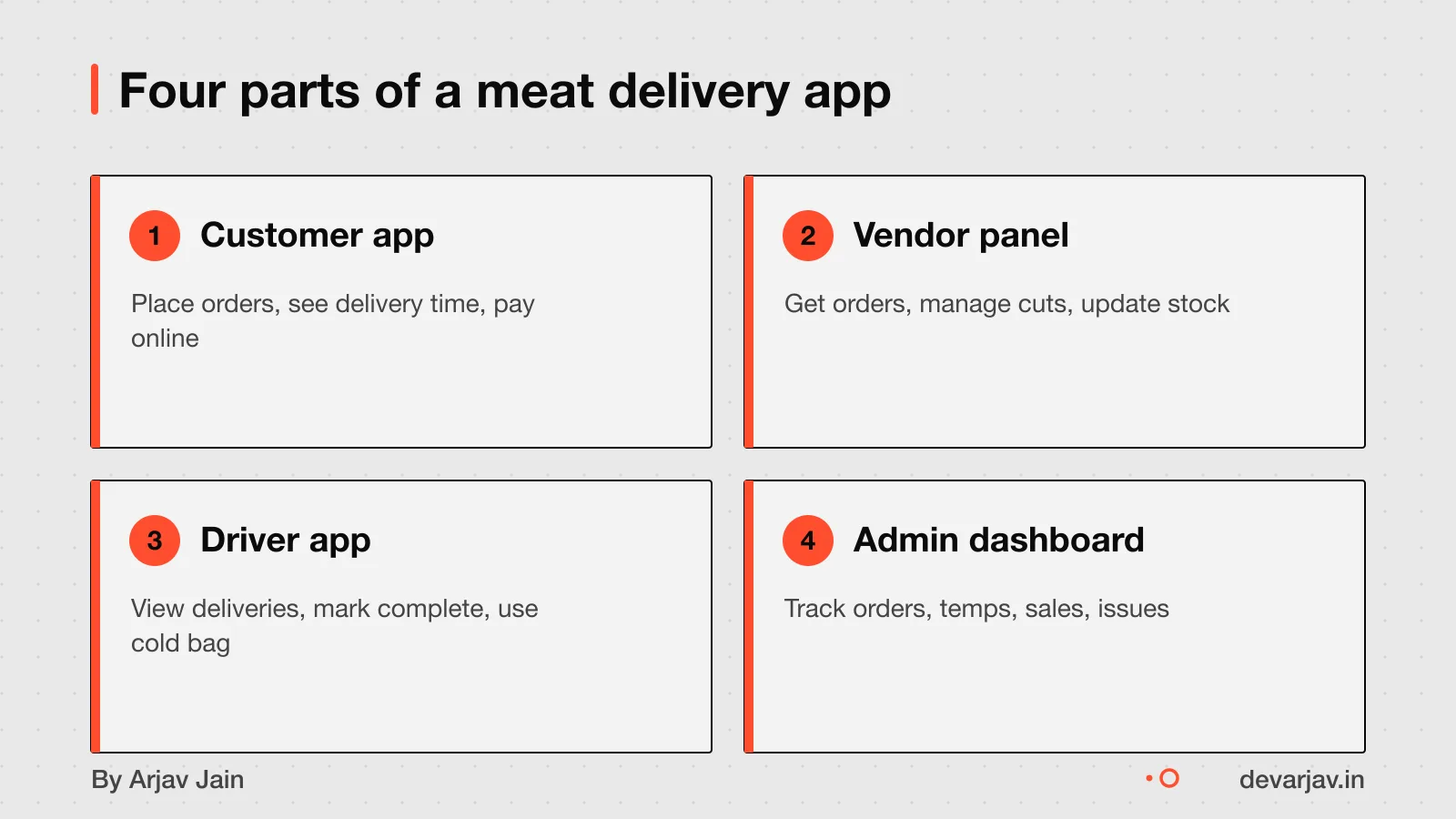
The app has four main parts: a customer app, a vendor or butcher panel, a driver app, and an admin dashboard.
You can see a full list of features in each panel on our guide to what features a meat and fish delivery app needs. Link: [/guides/what-features-does-a-meat-and-fish-delivery-app-need/].
Basic cost range: ₹18 to 65 lakh
This range is for a cross-platform app built with Flutter, which runs on both Android and iOS. It includes core features like a customer app, vendor panel, order management, real-time tracking, and basic cold chain monitoring. The cost varies based on features, platform, and complexity. For example, an app with real-time tracking and a vendor management panel may cost more.
A meat and fish delivery app may include features like temperature monitoring alerts, freshness status indicators, insulated packaging integration, and delivery time windows. You can see how this compares to a food delivery app and decide what complexity you really need.
Want a number for your idea? Send one line on WhatsApp. I reply with what drives the cost and what to cut.
Message me on WhatsAppWhat makes the cost go up?
Custom features and third-party tools raise the cost of your meat and fish delivery app the most. A branded look with custom animations can add 20 to 40% to the design cost alone. Real-time GPS tracking and live chat raise server costs by 25 to 50%. Cold chain features like temperature monitoring alerts and freshness status indicators add complexity and cost.
Each third-party tool you add costs ₹50,000 to ₹2,00,000 to integrate properly. These are not one-time fees. You may also pay monthly for API usage or support. Even basic functions like user login take 20 to 30 hours to build securely.
For example, if your base app costs ₹20 lakh, adding custom design could cost another ₹4 to 8 lakh. Adding three integrations, payment, maps, and WhatsApp, could add ₹1.5 to 6 lakh more. Real-time tracking could push server costs up by ₹5 to 10 lakh over two years.
To cut costs, focus on must-have features first. Delay branded animations, live chat, or advanced cold chain alerts until later. Use standard design elements and proven tools instead of custom code.
Have a quote in hand? Send it to me and I will mark what is missing.
Message me on WhatsAppCold chain and temperature tracking costs
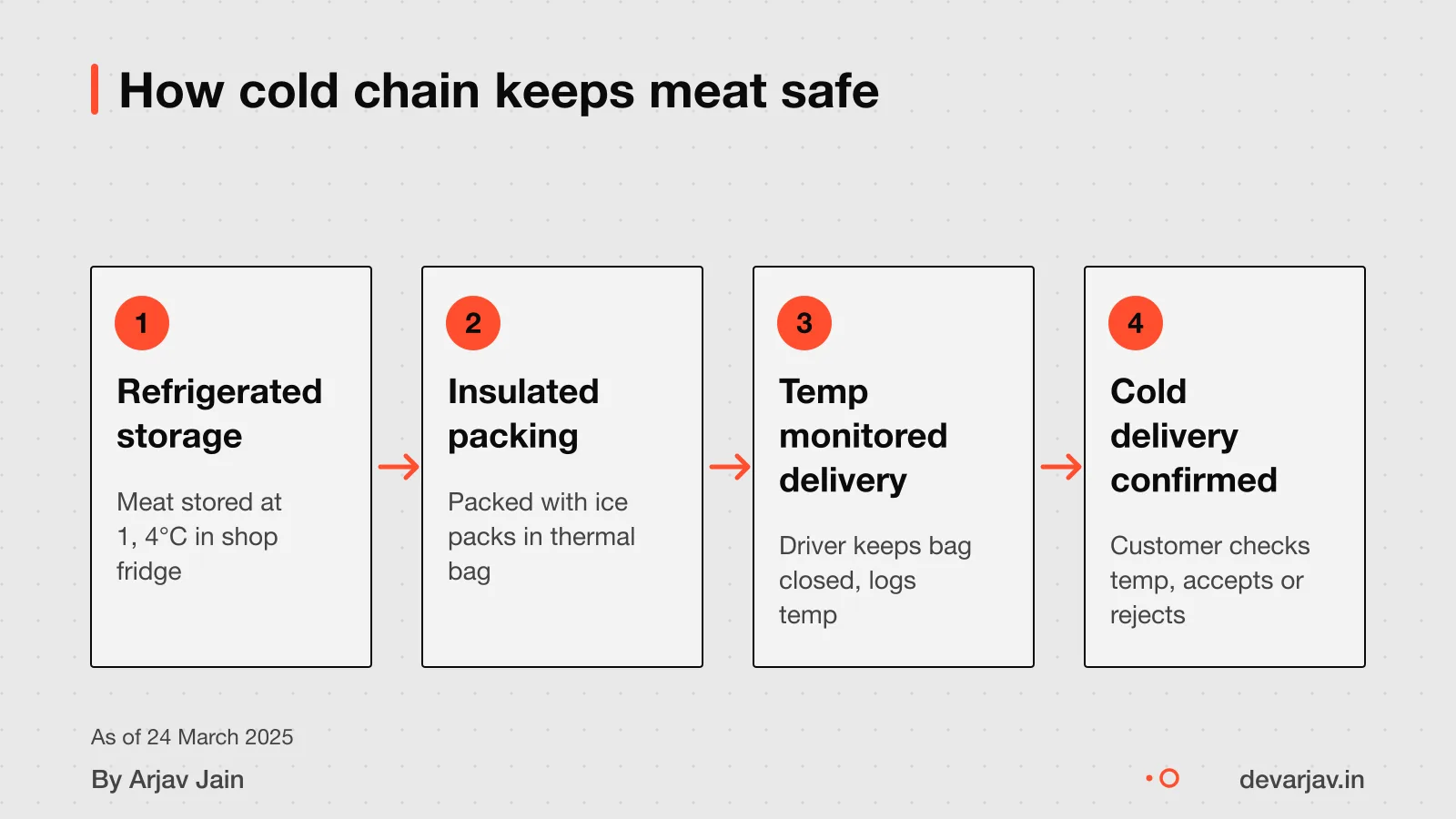
Cold chain tracking is essential because meat and fish spoil fast. You must keep them between 1°C and 4°C from storage to delivery to ensure freshness. This range stops bacteria growth and meets hygiene standards. Without it, customers get bad meat, leave bad reviews, and may get sick.
Tracking temperature in real time is non-negotiable for a credible meat delivery business. The app must log fridge and vehicle temps at each step. If the cold chain breaks, the system alerts you so you can act. This builds trust and keeps your brand reliable.
Refrigeration is the single largest recurring expense in cold chain logistics. It includes power, cooling units, backup generators, and routine maintenance. These costs are not part of the app development price. They are ongoing and tied to your delivery setup, not the software.
Cold storage also has high upfront costs for equipment and monitoring systems. You need sensors, refrigerated vans, and cold lockers. These are capital costs. The app only shows and logs the data, it does not replace hardware.
Cold chain logistics are significantly more expensive than dry logistics due to higher operational demands. This means your delivery costs per order will be higher than a grocery app. Plan for this in your pricing.
To learn how to build cold chain features into your app, see our guide on how to build cold chain features.
How long does it take to build?
Building a food delivery app from scratch in India takes 4 to 6 months. This includes planning, design, development, testing and launch. A white label app, which uses a ready-made template, can go live in 7 to 14 days. You choose a design, add your brand, and connect your delivery system.
Cross-platform tools like Flutter cut development time by 30 to 45% compared to building two separate apps for Android and iOS. This is because one codebase runs on both phones. For a fresh meat seller, this means faster launch and lower cost.
A simple app with basic features takes 4 to 6 weeks. But a meat delivery app is not simple. It needs weight-based pricing, cold-chain tracking, and freshness alerts. These features add time.
For a full scratch-built app, expect: - 4 to 6 months for custom development - 7 to 14 days for a white label launch - 30 to 45% time saved with cross-platform tools
full timeline by phase
Legal rules: FSSAI and state laws
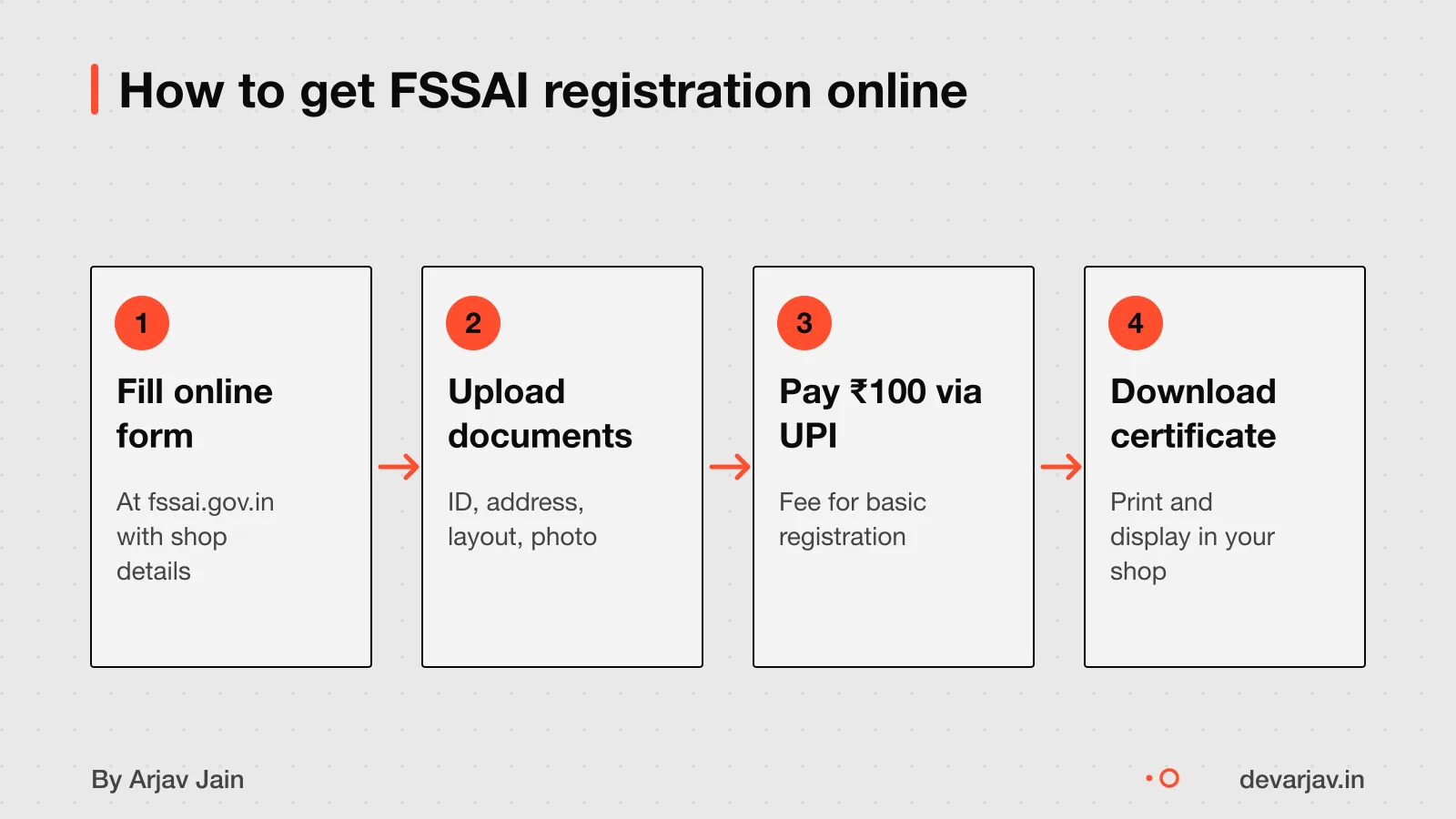
Yes, you need FSSAI registration or a license to run a meat and fish delivery app in India. If your yearly sales are ₹12 lakh or less, apply for basic registration, which costs ₹100 per year. If your sales are above ₹12 lakh, you need a license. The fee ranges from ₹2,000 to ₹5,000 per year, depending on your business type.
FSSAI rules apply to every part of your food business, including storage, labeling, and delivery. Since meat and fish are perishable, your app and delivery process must support cold-chain compliance, and FSSAI may inspect your operations. You must display your FSSAI number on the app and all packaging.
State laws may add extra rules, such as local health department approvals or animal slaughter restrictions. For example, some states require additional permits for handling beef or poultry. Always check with your local food safety officer.
Yearly maintenance cost
You should budget 15 to 20 per cent of your app’s build cost every year for maintenance. This covers hosting, security updates, bug fixes, and support when something breaks.
Maintenance includes keeping the app running on new phone OS versions, updating third-party tools, and fixing small issues users report. For example, if your app cost ₹50 lakh to build, set aside ₹7.5 to ₹10 lakh each year for upkeep.
This is a common industry estimate and may vary based on how often you update the app or add features. Actual costs depend on your developer, server bills, and how complex your app is.
Start simple and add features later
Start with a basic app that lets customers browse cuts, place orders, and pay securely. This core version includes a customer app, vendor panel, and admin dashboard. Build for one platform first, like Android, to cut cost and test demand. As an estimate, this MVP could cost within the lower end of the ₹18 to 65 lakh range. Though exact figures depend on your developer and location.
Adding features later, like real-time delivery tracking or cold chain alerts, will raise the total cost. Each new feature needs design, coding, and testing. As an estimate, assuming standard rates, adding cold chain tracking or dual-platform support (iOS and Android) could add ₹10 to 25 lakh. There is no published data on the exact cost to add features later. You should ask your developer for a modular quote that shows pricing per feature.
What if the cold chain fails?
If the cold chain breaks and meat spoils, you could face legal action, fines, or lose your FSSAI license. Liability may fall on any part of the chain that failed to keep temperatures safe, including your business. Customers can file complaints under the Consumer Protection Act for unsafe or spoiled products.
To protect your business, keep accurate, tamper-proof logs of temperature at every stage, from storage to delivery. These records help prove you followed safety rules if a claim arises. Severe negligence that causes harm can lead to prosecution under food safety or public health laws.
You must also notify customers and regulators quickly if a failure occurs. Delayed response increases risk.
Not sure if your project has this risk? Tell me the plan in two lines and I will say yes or no.
Message me on WhatsAppHow to check if a developer's quote is fair
This helps you see where your money goes and compare quotes clearly.
A quote should include core features such as real-time order tracking. If any of these are missing, the quote may underdeliver.
Red flags include no itemised breakdown or exclusion of cold chain and food safety features. A single lump-sum quote hides what you are actually getting. A quote that seems too low likely skips essential parts like compliance or multi-platform support.
If a developer offers a price below $18,000, ask what is left out, as a cross-platform meat delivery app typically costs $18,000 to $65,000. Many low quotes cover only the customer app and leave out the vendor and admin panels. Also check if the quote includes both Android and iOS versions, as most customers use both.
Worked example: cost for a 4-panel app with cold chain
Worked example: cost for a 4-panel app with cold chain
This example covers a cross-platform app (Flutter) for Android and iOS, a vendor panel, an admin dashboard, and a delivery partner app. It includes 40 screens, cold chain temperature tracking, weight-based pricing per 100g, one payment gateway, and WhatsApp Business API integration.
One payment gateway and WhatsApp API add ₹1.25 lakh each, using the mid-point of.
As an estimate, annual maintenance will be 15 to 20% of the original development cost.
Assumptions: 40 screens, Flutter cross-platform build, one payment gateway, cold chain tracking, weight-based pricing, two third-party integrations (payment and WhatsApp), average design and server uplift.
When this advice is not right for you
- You sell fewer than 10 orders a day. At this volume, WhatsApp or phone orders with a simple spreadsheet work better. The app cost will not pay for itself.
- You already use WhatsApp for all orders and have no delivery delays or wrong cuts. If your current system is fast and accurate, an app adds little value.
- Your customers buy in bulk, such as B2B sales to hotels or canteens. A custom app is too complex; a shared catalog with order forms is cheaper.
- You own a refrigerated delivery fleet and drivers. The app’s cold-chain tracking may not save you extra time or money.
- You plan to launch in just one city and will not scale. A basic website or social media page with a menu and contact number is enough.
Related reading: full list of features, how this compares to a food delivery app, Best tech stack for a meat and fish delivery app in India.
Next step: message me on WhatsApp with what you want to build. No forms, no sales team.
Message me on WhatsAppAssumptions behind the numbers
- Assumes ₹1500/hour team rate
- Assumes 5-month development time
- Cost estimate excludes cold chain hardware
Work out your own number
I won't hand you a number that pretends to be the market. Instead, here is the working: set the weeks, the people and the rate, and see where the money goes.
Your working total
₹4,40,00011 weeks × 2 people × 5 days × ₹4,000- Scope and design18%
- Build55%
- Testing and fixes18%
- Launch and stores9%
The weeks shown are an example of a small app, there to be changed. Fees you pay others (store accounts, cloud, SMS) are not in this total.
What moves the price
- More screens or roles
Each extra user type (customer, admin, rider) is close to another app.
- Real-time features
Live tracking and chat need more design and more testing.
- Many integrations
Every payment, SMS, maps or ERP link is its own piece of work.
- Cold chain compliance
Temperature logging and alerts add weeks and hardware cost.
- FSSAI-certified flow
Adding licence checks and audit logs raises scope and time.
- Cutting to one platform first
Starting with one clear flow can be half the work.
- Using managed services
A managed backend for login and data removes weeks.
- A clear scope up front
Changes mid-build are the most expensive weeks.
Fees that go to someone else
Google Play developer account
A one-time registration fee, paid to Google. Check the current amount.
Apple Developer Program
A yearly fee paid to Apple. Check the current amount.
Cloud, SMS, maps, payments
Usage-based, billed by the provider to you.
FSSAI registration or license
₹100/year for registration; ₹2,000 to ₹5,000 for a license.
Ask for these before you sign
- How many weeks per phase, and with how many people?
- What is not included?
- Which fees do I pay to others directly?
- What happens to the price when I change my mind?
- What does the first month after launch cost?
Questions people ask
How much does it cost to build a meat and fish delivery app in India?
A meat and fish delivery app built with cross-platform tools like Flutter costs between $18,000 and $65,000. Some developers suggest a mid-range product with both iOS and Android apps, real-time tracking. A vendor management panel may cost between $30,000 and $70,000.
What adds the most cost to a meat delivery app?
Cold chain features, third-party tools, and real-time tracking add the most cost. Temperature monitoring and freshness indicators increase complexity, and each integration like payments or maps can add ₹50,000 to ₹2 lakh.
How long does it take to build this app from scratch?
Building a food delivery app from scratch in India takes 4 to 6 months. Using cross-platform tools like Flutter can reduce this time by 30 to 45% compared to building two separate apps.
Do I need FSSAI registration for my meat delivery app?
You need FSSAI registration or a license depending on your business. If your annual turnover is ₹12 lakh or less, you need registration. If turnover is above ₹12 lakh, you need a license. This is required for all food businesses under the FSS Act, 2006.
How much does FSSAI registration cost?
FSSAI registration costs ₹100 per year. A license costs between ₹2,000 and ₹5,000 per year for some professions.
What is the yearly maintenance cost?
As an estimate, yearly maintenance costs 15 to 20% of the app’s build cost. This covers updates, hosting, security fixes, and support. For a ₹50 lakh app, expect ₹7.5 to ₹10 lakh per year.
Can I start with a basic app and add features later?
Yes, start with a basic app that includes customer, vendor, and admin panels. You can add features like cold chain tracking or loyalty programs later. This reduces initial cost and risk.
What if a customer gets spoiled meat due to cold chain failure?
You may face legal action, fines, or loss of license if a cold chain failure leads to spoiled meat. Keeping accurate temperature logs helps defend your case and prove compliance.
Who owns the app code after it is built?
You own the app code once it is built. You can transfer it to another developer or platform at any time. The app stays live during the transfer.
Can I move my app to another developer later?
Yes, you can move your app to another developer. The app remains available on the store during the transfer. You will need to share access to your developer account.