What is quick commerce and how is it different?
Quick commerce means delivering orders in 10 to 30 minutes using nearby delivery networks. This is faster than regular food or grocery apps, which usually take 45 minutes or more.
The key difference is the promise of 10 to 30 minute delivery. To meet this, businesses use dark stores, small warehouses in busy areas, or micro-fulfilment centres inside existing shops. These hold only the items people order most, so picking and packing is faster.
For example, Blinkit and Zepto stock high-demand snacks, drinks, and medicines in dark stores across cities. When you order, a rider picks it up within minutes, not hours.
Regular delivery apps like Swiggy or BigBasket serve full grocery lists from larger stores, so they take longer. Quick commerce apps are built for speed, not variety.
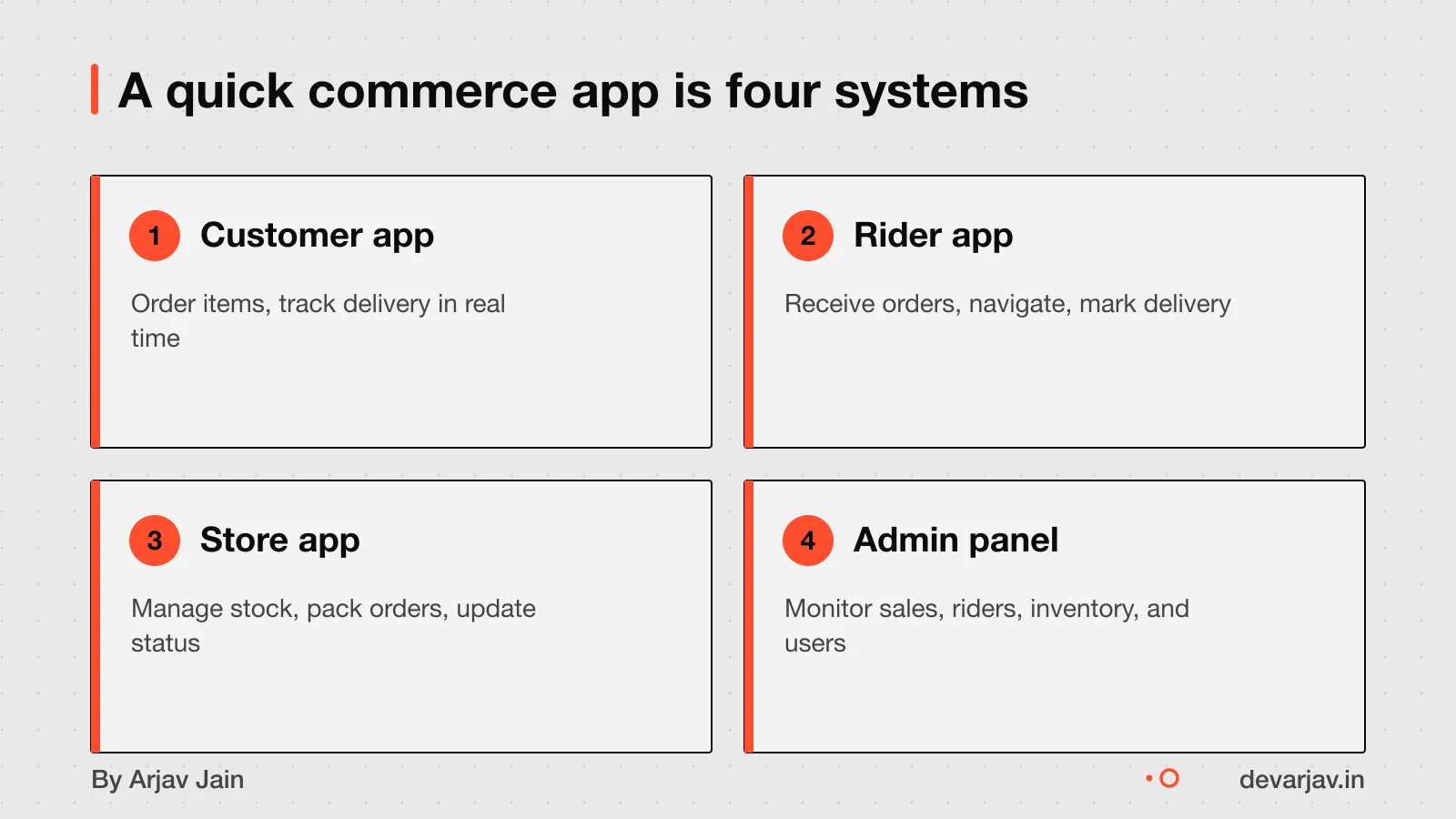
This model needs tight coordination between inventory, staff, and riders. The app itself is not just one piece, it’s four systems working together: customer, rider, store, and admin.
Must-have features of a quick commerce app include real-time tracking, smart dispatch, and inventory sync. Without these, 10-minute delivery is not possible.
A quick commerce app is four systems, not one
Each serves a different user and adds to the cost. You need all four for the system to work.
The customer app lets buyers search for items, place orders, and track delivery in real time. This is what most people think of as the "app". But behind it are three more systems.
The rider app helps delivery partners accept orders, see the best route, and check their earnings. Without it, riders cannot manage deliveries efficiently.
The admin panel gives you control. You can view all orders, update inventory, manage riders, and handle customer support. It is the nerve centre of the business.
Building four apps costs more than one. Each has its own design, development, testing, and maintenance. You cannot skip any if you want full control.
how to build a quick commerce app
What adds the most cost: inventory sync and dispatch logic
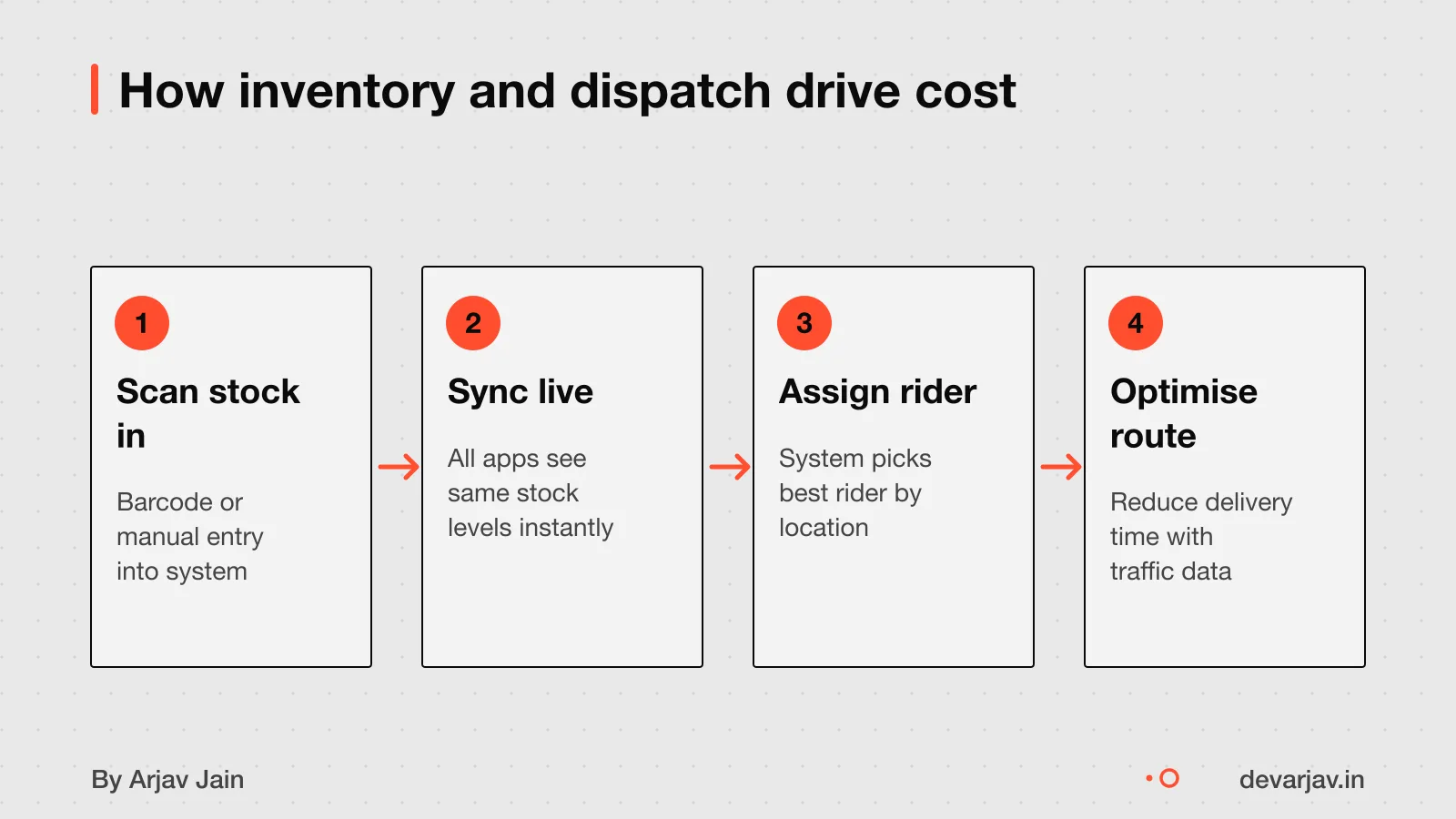
These systems run in the background and make sure orders do not fail when stock changes fast or riders are stuck in traffic. A customer sees a simple "Buy Now" button, but behind it, the app must check live stock. Assign the nearest rider, and plan the fastest route, all in seconds.
Quick commerce apps require real-time logistics, route optimization, and smart automation for efficient delivery. If two orders go to the same street, the system must combine them automatically. This smart automation raises the cost because it is not a one-time build, it needs constant updates and testing.
For example, if a customer orders milk and bread, the app must confirm both items are in stock at the nearest store. If the rider is already on the way, the system must re-route them without delay. Without this logic, orders get cancelled, customers are angry, and delivery costs rise.
These systems are harder and more expensive than building the customer app because they must work perfectly under pressure. They also need links to inventory software and GPS tracking, which adds to the build time and cost. The best tech stack for quick commerce can reduce some effort [best tech stack for quick commerce].
How cost grows with live tracking, offers, and more stores
Adding live tracking, offers, and more stores increases cost in clear phases. A growth build with live tracking, digital wallets, and promo codes costs $50,000 to $90,000. This phase includes syncing stock across dark stores, a vendor dashboard, and basic reporting tools. For example, live tracking needs real-time GPS updates from riders and affects dispatch logic, which raises backend complexity.
When you add multiple stores or cities, the cost jumps to $120,000 to $250,000 or more. This includes AI-based rider routing, demand forecasting, and linking to external systems like ERP or POS. As an estimate, adding AI routing and multi-warehouse support nearly doubles the work from the growth phase. Each new city needs local inventory rules, rider staffing plans, and outage backups.
These phases assume you already have an MVP with a working customer app, store panel, and dispatch system. If not, the base cost will be higher. You may reduce costs by using existing delivery platforms instead of building a rider app. See options to build or buy a quick commerce app based on your order volume and control needs.
How long does it take to build?
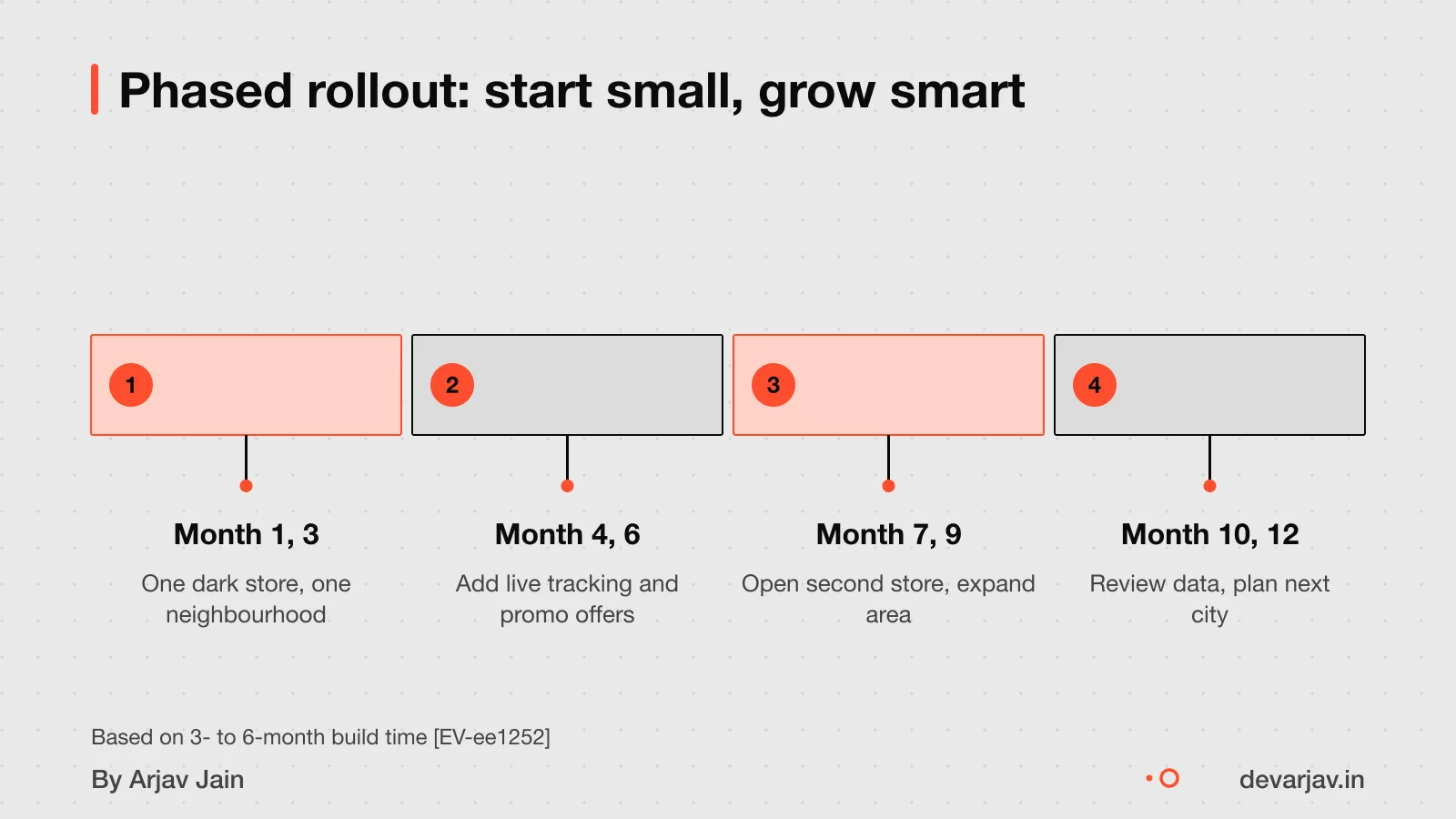
A custom quick commerce app takes 3 to 6 months or more to build for one city. This timeline assumes a full team working on all four systems: customer, rider, store, and admin. Smaller teams may take longer, but adding more people does not cut time in half. Complex features like live inventory sync or dynamic dispatch logic can push development past 6 months. For example, syncing stock every 30 seconds across 200 SKUs while handling rider location updates needs careful testing. Team size helps only if the core architecture is stable. Rushing often leads to crashes during peak orders.
You can see a detailed timeline for quick commerce apps with phase-by-phase estimates.
Solo developer, team, or agency: which is right?
A solo developer costs less but can take longer, while a team delivers faster but at a higher price. A solo developer works best when your timeline is flexible and the app has standard features. A team makes sense when you need speed, complex logic, or parallel work on customer, rider, and admin apps. With a team, you pay more but reduce the risk of delays. For example, building all four systems at once requires mobile, backend, and admin work happening together, which a team can handle.
An agency may help if you need full project management, design, testing, and legal checks bundled together. But agencies often charge a premium for coordination, not just code. If you already understand the scope and can manage timelines, a solo developer or a small team is more cost-effective. You can find skilled developers through trusted networks or platforms, but check their past work in inventory or dispatch systems.
For a clear comparison of options, see our guide on freelancer or agency for your first app.
Biggest risks: cash flow, inventory, and system crashes
Poor cash flow causes 82% of new small businesses to fail within five years. This happens when money coming in does not cover daily costs like rent, staff, and stock. Quick commerce stores need cash to buy inventory before they earn from sales. Since dark stores typically take six to 12 months to reach maturity and profitability. You must have enough funds to last through slow early months.
Stock inaccuracy hurts your business by causing order failures. If your app shows an item in stock but it is actually sold out, the order gets cancelled. This upsets customers and wastes rider time. Over time, trust drops and people stop using your app.
You should ask your developer how they plan for system failures during high traffic.
Handling out-of-stock items well can reduce cancellations. You can let customers choose a substitute or get a refund. The store staff need clear rules and a simple tool to act fast.
Not sure if your project has this risk? Tell me the plan in two lines and I will say yes or no.
Message me on WhatsAppWorked example: cost for a single-city MVP
As an estimate, a ₹25 lakh minimum viable product (MVP) for a single-city quick commerce app includes four systems. This covers basic features like browsing items, adding to cart, and placing orders. It also includes one payment gateway and simple order tracking. This lets delivery staff accept orders, navigate routes, and mark deliveries as complete. It uses live location tracking and push alerts. The store tool is part of a single-city MVP that costs $25,000 to $45,000. This is where staff update stock, manage orders, and prepare packages. It runs on a phone or tablet inside the store. This system tracks sales, manages users, and checks performance. It supports one city and basic reports.
These numbers assume a single city, manual inventory updates, no wallet or coupons, and a development time of 8 to 12 weeks. The total is estimated from a $25,000 to $45,000 range, converted at ₹83 per dollar as of 24 September 2026. This MVP does not include dark store sync, advanced dispatch logic, or third-party delivery integrations.
| System | Estimated Cost | |---------------|----------------|
How to start: define scope, pick team, get quote
Start by defining what your app must do. Cut every non-essential feature. An honest developer will help you prioritise for an MVP. For example, start with only one delivery zone and a fixed menu.
Next, decide who builds it. A solo developer costs less but moves slowly. A team costs more but delivers faster. Get at least three quotes. Compare what each includes and excludes.
Test demand before building. Run a manual pilot using WhatsApp or phone orders. Share a list of items and take orders. If you get paid orders, demand may be strong enough.
This advice is for businesses in one city with stable supply. It does not apply if you cannot fulfill orders manually right now.
Next step: message me on WhatsApp with what you want to build. No forms, no sales team.
Message me on WhatsAppHow inventory gets into the app: manual, barcode, or software sync
You can add inventory to your quick commerce app in three ways: manual entry, barcode scanning, or software sync. Each has trade-offs in accuracy and effort.
As an estimate, small stores with under 500 SKUs often start with manual or barcode methods. Larger operations with fast turnover use software sync to avoid overselling. The choice affects how often your app shows wrong stock levels, which leads to cancelled orders.
Should you build a rider app or use Swiggy, Dunzo, or other platforms?
Using Swiggy, Dunzo, or other delivery platforms gives you speed and cuts initial cost. But you pay per delivery and have less control over the customer experience. Building your own rider app means higher upfront cost and added complexity. But you keep full control of delivery times, rider behaviour, and customer data.
These fees add up fast, especially if you run discounts or high-volume days. You also cannot customise the delivery message, track riders beyond the app, or reassign orders during delays.
Using third-party delivery makes sense when your daily order volume is under 50. You are testing demand, or you do not have the budget for a full team. It is a low-risk way to start.
For more on this choice, see the full comparison of build or buy a quick commerce app.
When this advice is wrong: low order volume or unstable supply
When this advice is wrong: low order volume or unstable supply
Do not build a quick commerce app if your daily order volume is under 50 to 100. At that level, the cost of four apps, customer, rider, store, and admin, plus dispatch logic and inventory sync will not pay for itself. The unit economics do not work when each order must cover high tech and staff costs.
This advice is also wrong if you cannot staff a dark store reliably. Quick commerce depends on fast, accurate picking and dispatch. If your team turns over fast or shifts are hard to fill, delays and errors will hurt your reputation and increase refunds.
Instead, test demand with cheaper alternatives like WhatsApp commerce. You can take orders over WhatsApp, use local delivery riders by the hour, and manage stock in a spreadsheet. This costs almost nothing to start and shows if customers want fast delivery from you.
As of now, the exact order density needed per square kilometre is not known, and the minimum viable order value for profit is not published. You should check your area by running a small test with a simple system.
Assumptions behind the numbers
- Day rate is ₹4,000 per developer per day
- Team size affects calendar time with diminishing returns
- Base features are pre-selected as minimum viable
Build your own estimate
A quick commerce app is not one app. It is a customer app, a rider app, a dark-store tool and an admin. Switch things on and watch the cost move.
Your working total
₹2,10,00010.5 developer-weeks × 5 days × ₹4,000 a dayCustomer app
Rider app
Dark store tool
Admin and backend
Where this goes wrong
- 01Inventory accuracy
The app is only as good as the shelf count. Plan for how stock reaches the system before you plan screens.
- 02Rider supply
Software does not create riders. Decide whether you build the rider app or use an existing fleet.
- 03Peak load
Evening rush is a different test from a demo. Ask how it is tested.
Ask for these before you sign
- Are the customer, rider and store apps all in this quote?
- Which area and how many stores does the first version serve?
- Who owns the inventory data feed?
- How is peak load tested?
Questions people ask
How much does a quick commerce app cost in rupees?
As an estimate, a single-city MVP quick commerce app costs $25,000 to $45,000. This covers the customer, rider, store, and admin apps for basic delivery in one city. The actual cost depends on features like live tracking or digital wallets.
Why is it so expensive compared to a normal app?
A quick commerce app includes multiple apps: customer, rider, store, and admin. It also needs real-time backend logic for inventory sync and route optimisation. This complexity drives cost beyond a standard app.
Can I start with just the customer app?
Yes, you can start with just the customer app to test demand. But full value comes only when all four systems work together. Without the rider and store apps, you cannot deliver orders reliably.
Do I need GST registration for my quick commerce business?
Yes, you must register for GST as a quick commerce operator even if your turnover is low. This is because you fall under the e-commerce operator category. Check this for your case with a chartered accountant.
Is FSSAI needed if I sell groceries?
Yes, FSSAI registration is compulsory if you sell groceries, packaged foods, dairy, or beverages. This is required under the Food Safety and Standards Act, 2006. Check this for your case with a food safety officer.
What third-party services will I pay for monthly?
You will pay for UPI transaction fees (2% + GST). These add up over time and are often missed in early quotes. See the full list of hidden costs for e-commerce.
Who owns the app after I pay for it?
Ownership must be clearly written in the contract. Payment alone does not transfer all rights. Developers may keep rights to tools or libraries used. Ask for full source code and IP transfer in writing.
How long before a dark store becomes profitable?
A dark store typically takes 6 to 12 months to reach maturity. Cash flow is a major risk, as costs for rent, staff, and stock come early. Monitor daily sales and delivery success rates.
Can I use Swiggy or Dunzo riders instead of building my own app?
Yes, you can use Swiggy, Dunzo, or other platforms to deliver orders. This cuts development cost but adds per-delivery fees and less control. You also depend on their rider availability.